Compound Sentences Worksheets
About This Worksheet Collection
Compound sentences join two independent clauses, or complete thoughts, into one sentence. Writers commonly connect the clauses with a comma and a coordinating conjunction such as for, and, nor, but, or, yet, or so. Understanding this structure helps students combine related ideas clearly while avoiding run-ons, comma splices, and repetitive short sentences.
This collection develops compound-sentence skills through conjunction identification, sentence classification, clause matching, sentence combining, completion activities, editing tasks, informational reading, and original writing. Some worksheets provide sentence parts or answer choices, while others ask learners to select logical conjunctions, repair errors, or build compound sentences independently. The pages can be used during grammar instruction, writing centers, guided practice, intervention, tutoring, homework, review, assessment, or homeschool lessons.
As students complete the collection, they strengthen independent-clause recognition, FANBOYS conjunction knowledge, comma placement, sentence boundaries, logical reasoning, editing, and writing fluency. They also practice distinguishing compound sentences from simple and complex structures, choosing connectors based on meaning, and revising choppy or run-on writing. These skills help learners create sentences that are clearer, smoother, more varied, and easier for readers to understand.
Detailed Descriptions Of These Worksheets
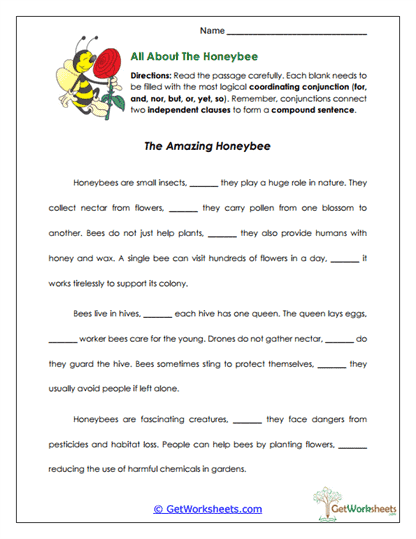
All About the Honeybee
An informational passage about honeybees gives students a meaningful setting for practicing coordinating conjunctions. Learners use context to decide which connector best joins facts about hives, pollen, worker bees, queens, and environmental threats. Because the examples form a connected passage, children must understand the information as well as the grammar. The page combines nonfiction reading, science vocabulary, clause recognition, and sentence fluency.
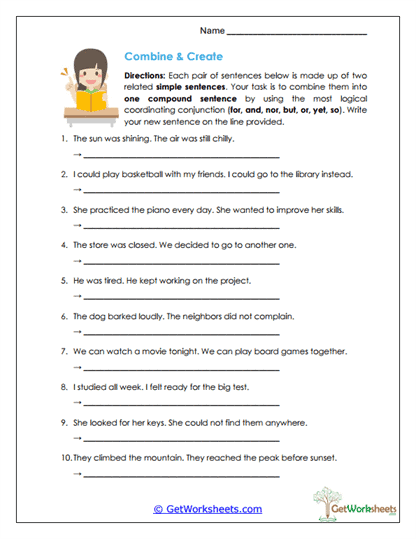
Combine and Create
Pairs of short, related sentences are rewritten as single compound sentences. Students select a coordinating conjunction that accurately shows addition, contrast, choice, reason, or result and place a comma before it. The activity helps learners move beyond using "and" for every connection. It also gives developing writers a practical strategy for making their work sound less choppy and more mature.
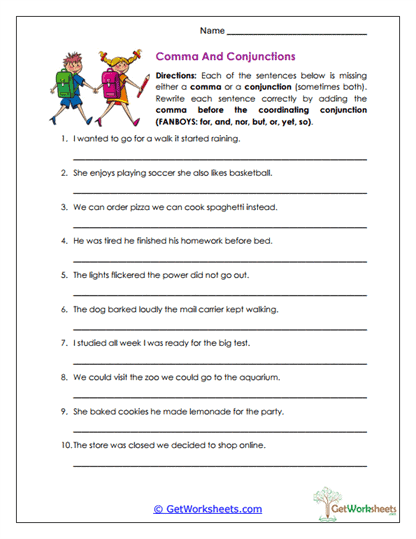
Comma and Conjunctions
Run-together sentences must be repaired by adding both punctuation and a suitable FANBOYS conjunction. Learners identify where one independent clause ends and the next begins before choosing a connector that fits the meaning. Rewriting each example reinforces the correct comma placement. This editing practice helps students avoid fused sentences and comma splices in their own writing.
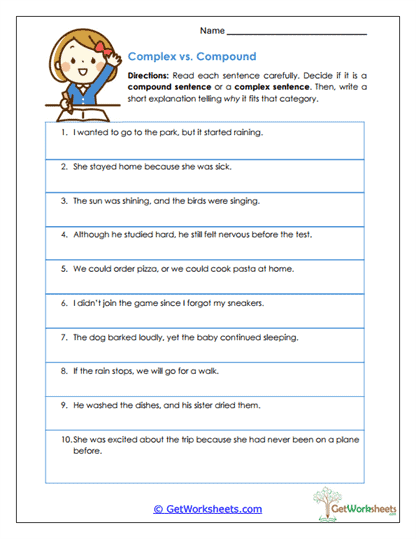
Complex vs. Compound
Students compare compound sentences with complex sentences and explain how each example is structured. They determine whether the sentence contains two independent clauses or one independent clause joined to a dependent clause. Coordinating and subordinating conjunctions provide useful clues, but learners must also consider whether each clause can stand alone. The written explanation encourages accurate grammar vocabulary and deeper sentence analysis.
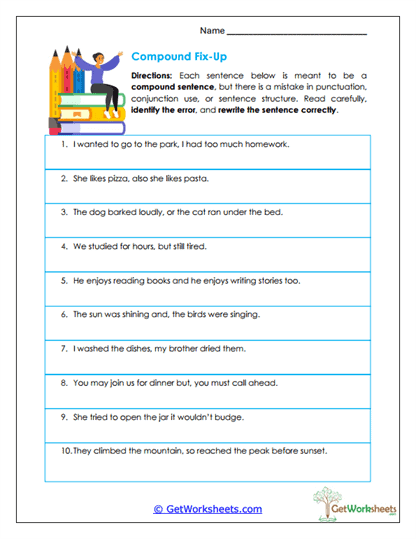
Compound Fix-Up
Sentences intended to be compound contain errors involving punctuation, conjunctions, repetition, or clause structure. Students diagnose the specific problem and rewrite each sentence without changing its main ideas. Because the mistakes vary, learners cannot use the same correction every time. This activity develops flexible editing skills and encourages careful attention to both grammar and meaning.
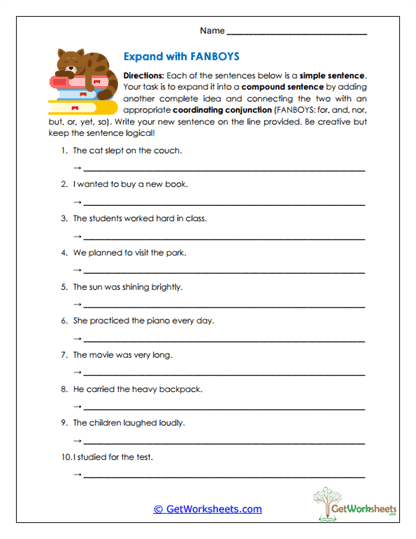
Expand with FANBOYS
A provided independent clause becomes the beginning of a new compound sentence. Students create a second complete thought, select an appropriate FANBOYS conjunction, and use the required comma. The open-ended structure allows many possible correct responses while still reinforcing precise grammar rules. It is especially useful for helping children add detail and variety to short writing.
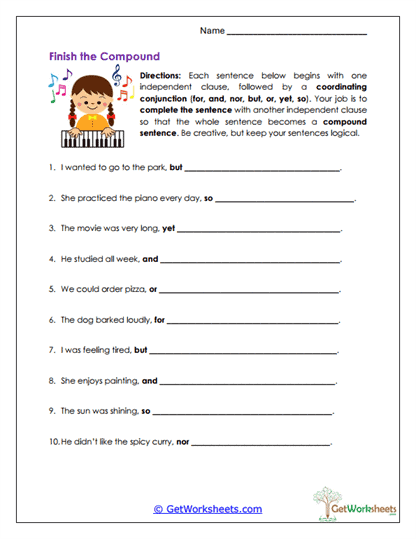
Finish the Compound
Sentence beginnings and coordinating conjunctions are supplied, but students must create the second independent clause. Their endings need to be complete, logical, and consistent with the meaning of connectors such as but, so, yet, or, and, for, and nor. Saying the full sentence aloud can help learners hear whether the relationship works. The activity provides a bridge from guided sentence work to more independent writing.
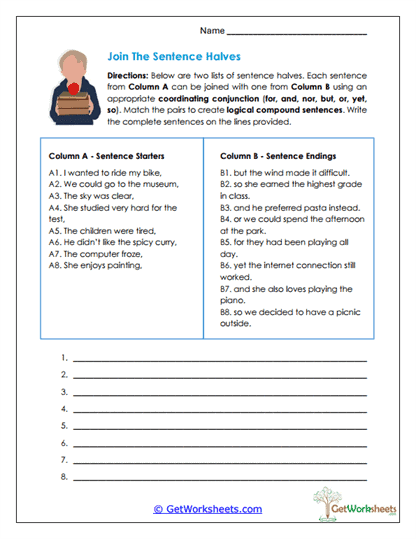
Join the Sentence Halves
Students match independent-clause beginnings with endings that make logical sense. After choosing the correct pair, they select a coordinating conjunction and rewrite the ideas as a properly punctuated compound sentence. The process separates sentence building into manageable stages: matching, connecting, and writing. It strengthens logical reasoning as well as clause recognition and punctuation.
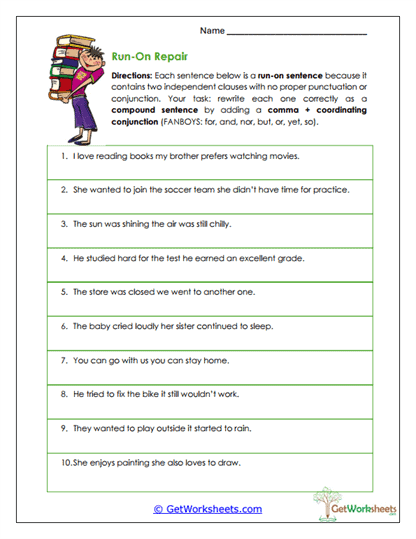
Run-On Repair
Two complete thoughts have been pushed together without proper punctuation or a connecting word. Learners identify both independent clauses and join them with a comma and a logical coordinating conjunction. The activity teaches a dependable correction strategy students can use when revising their own drafts. It also reinforces how conjunction choice affects the relationship between ideas.
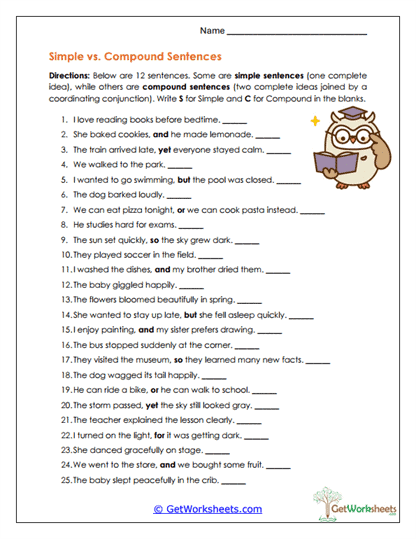
Simple vs. Compound Sentences
A mixed list asks students to classify sentences according to the number of independent clauses they contain. Learners discover that sentence length and the presence of words such as "and" do not automatically determine the structure. A simple sentence may include several details or a compound predicate while still containing only one complete thought. This repeated comparison strengthens clause analysis and helps correct common classification mistakes.
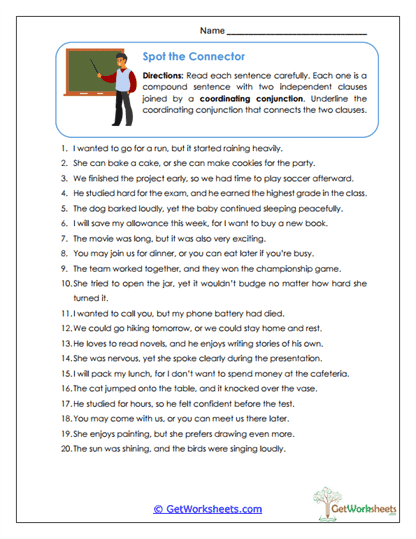
Spot the Connector
Students underline the coordinating conjunction that links the independent clauses in each compound sentence. Focusing on the connector helps them notice how words such as but, so, yet, or, and, for, and nor express different relationships. Learners can also test the structure by checking whether both sides make sense as complete sentences. This focused activity builds a strong foundation for punctuation and sentence construction.
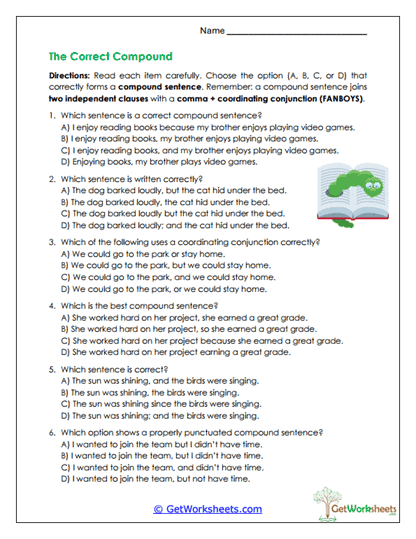
The Correct Compound
Several versions of a sentence are compared, and students choose the one with correct clause structure, conjunction use, and comma placement. Incorrect options may contain missing punctuation, illogical connectors, fragments, or run-ons. Examining these small differences encourages careful proofreading. The activity works well as review, assessment, or preparation for editing compound sentences independently.
Bookmark Us Now!
New, high-quality worksheets are added every week! Do not miss out!