Sentence Fragments Worksheets
About This Worksheet Collection
Sentence fragments are incomplete groups of words that do not express a full thought. A fragment may be missing a subject, a verb, or an independent clause, even when it contains several meaningful words. Learning to recognize and repair fragments helps students write sentences that are clear, complete, and easy for readers to understand.
This collection develops fragment skills through sentence classification, missing-part activities, rewriting practice, sentence combining, passage editing, error diagnosis, and style analysis. Some worksheets focus on one specific problem, such as a missing subject or predicate, while others ask learners to find fragments inside stories and informational passages. The pages can be used during grammar lessons, writing workshops, intervention, tutoring, homework, assessment, or homeschool instruction.
As students complete the collection, they strengthen subject and predicate recognition, clause awareness, sentence construction, punctuation, paragraph coherence, and editing judgment. They also practice choosing the most effective repair, explaining why a group of words is incomplete, and distinguishing accidental fragments from intentional stylistic choices. These skills support stronger narratives, essays, reports, and everyday writing.
Detailed Descriptions Of These Worksheets
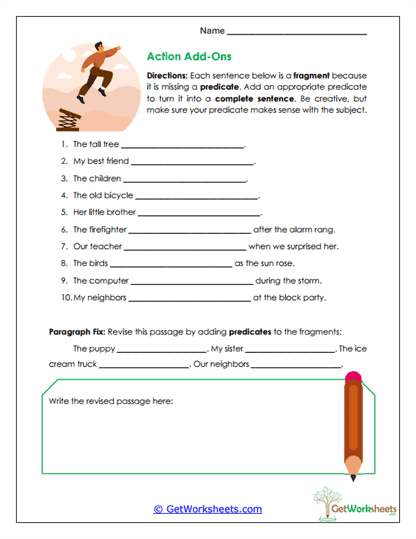
Action Add-Ons
Provided subjects must be completed with predicates that create clear and logical sentences. Students choose verbs and supporting details while checking subject-verb agreement and overall meaning. A paragraph activity gives them additional practice completing several related ideas. The open-ended format encourages creativity while reinforcing that every sentence needs a finished predicate.
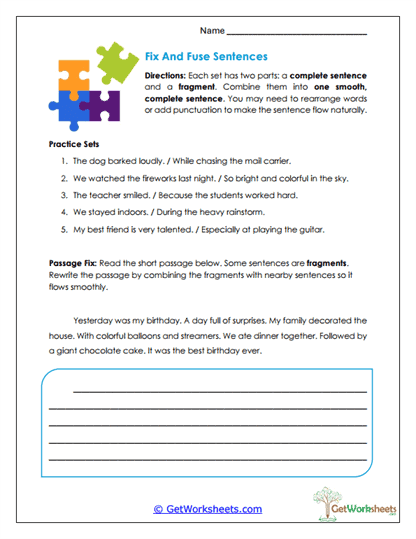
Fix and Fuse Sentences
Students combine complete sentences with nearby fragments that provide extra details or explanations. They decide where each incomplete phrase or dependent clause belongs and rewrite the ideas with correct punctuation. The activity demonstrates that attaching a fragment to a related sentence is often more natural than adding unrelated words. Passage-level practice also helps learners improve paragraph flow and coherence.
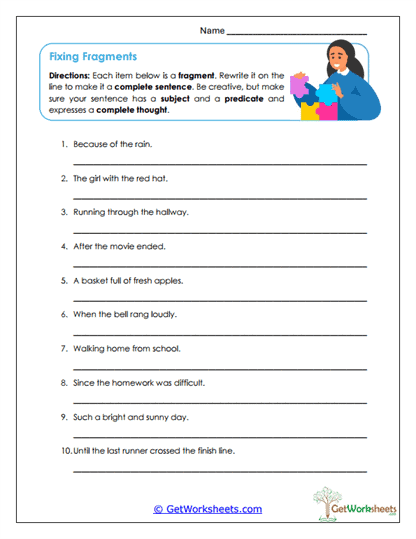
Fixing Fragments
Each incomplete thought must be rewritten as a complete sentence. Learners identify whether the fragment needs a subject, predicate, or independent clause before adding meaningful information. Several different corrections may be acceptable when the result is logical and grammatically complete. This activity moves students beyond recognition and gives them practical revision experience.
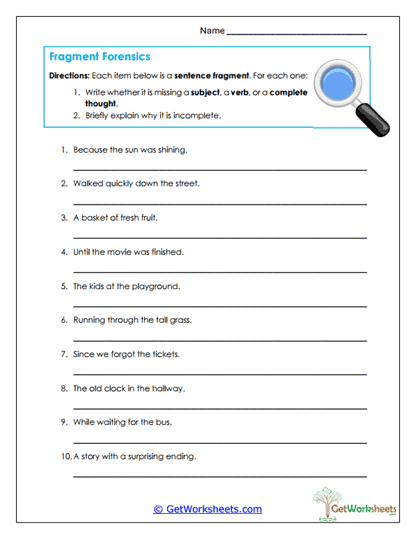
Fragment Forensics
Students investigate the exact reason each example is incomplete. They classify fragments as missing a subject, missing a verb, or lacking a complete main thought and then explain their decision with grammar vocabulary. The diagnostic format shows that not all fragments have the same structural problem. It is especially useful for assessing deeper understanding and choosing the correct repair.
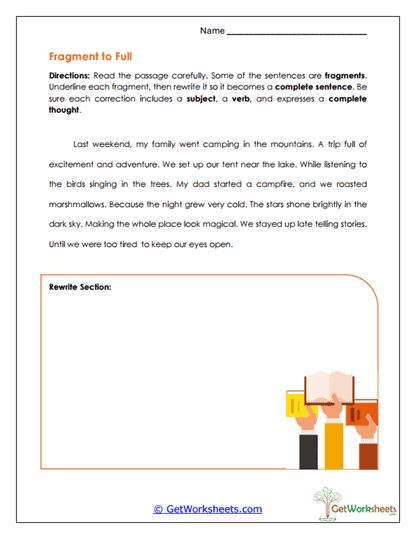
Fragment to Full
A camping passage contains fragments that students must locate and revise. Learners examine each sentence within the context of the story, decide what is missing, and rewrite the paragraph so it flows smoothly. Some fragments may be expanded, while others may be joined to nearby complete thoughts. This activity connects sentence correction with paragraph coherence and storytelling.
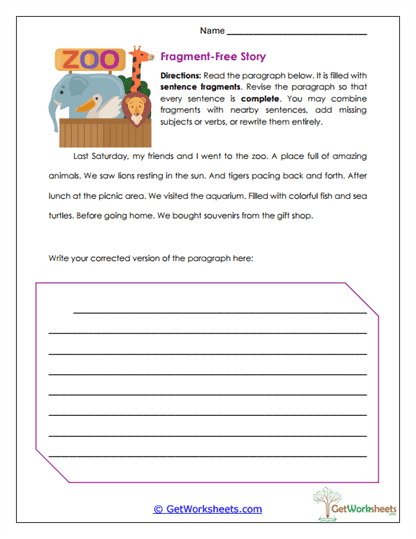
Fragment-Free Story
Students repair a zoo passage containing several incomplete sentences. They may add missing subjects or verbs, combine related ideas, or revise awkward wording while preserving the events of the story. Working within a full paragraph makes the fragments less obvious and requires careful editing. The final rewrite strengthens both grammar accuracy and narrative flow.
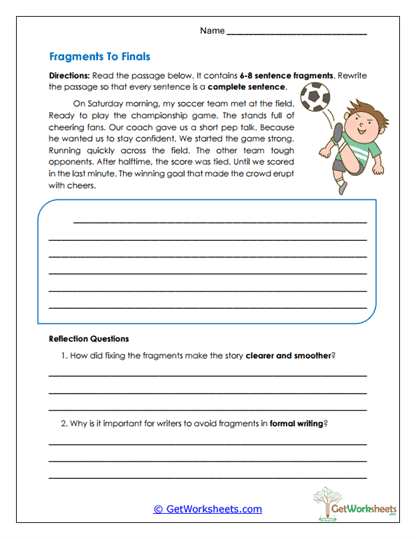
Fragments to Finals
A soccer passage challenges students to find and correct fragments hidden among complete sentences. Learners choose an appropriate repair for each problem and then rewrite the passage without changing its meaning. Reflection questions ask them to consider how sentence completeness affects clarity and formality. This activity is well suited for older learners who are ready for more independent paragraph revision.
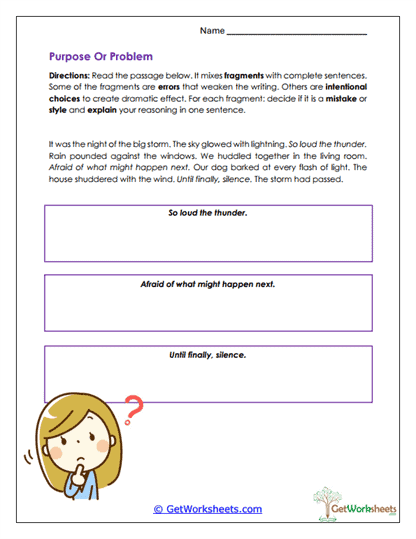
Purpose or Problem
Students examine fragments within a dramatic storm passage and decide whether each one is accidental or intentionally used for effect. They consider how short incomplete phrases may create suspense, emphasis, rhythm, or tension in creative writing. The activity also asks learners to think about why the same style may be unsuitable in formal academic work. This advanced practice connects grammar with author's purpose and writing style.
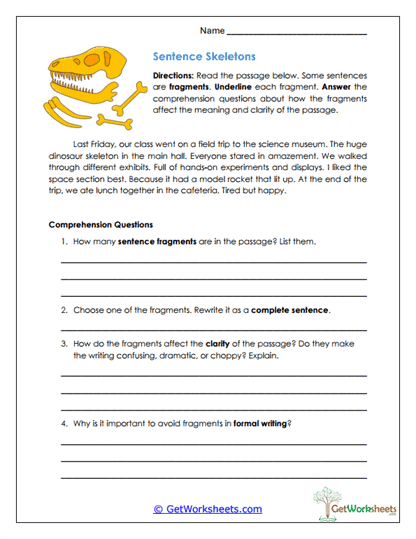
Sentence Skeletons
An informational passage about a science museum contains fragments that affect its clarity. Students identify the incomplete thoughts, list them, repair an example, and explain how the fragments influence the reader's understanding. The worksheet emphasizes that grammar supports comprehension in formal writing. It combines close reading, sentence revision, and written analysis.
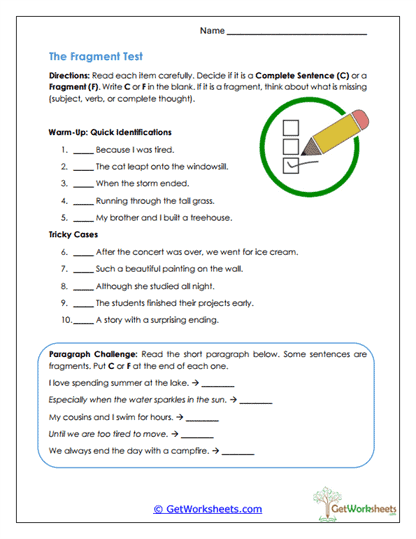
The Fragment Test
Students classify groups of words as complete sentences or fragments by checking for a subject, verb, and finished thought. The examples include missing sentence parts, phrases, and dependent clauses that may initially sound complete. A paragraph challenge asks learners to apply the same test within connected writing. This provides a dependable foundation for later editing and revision work.
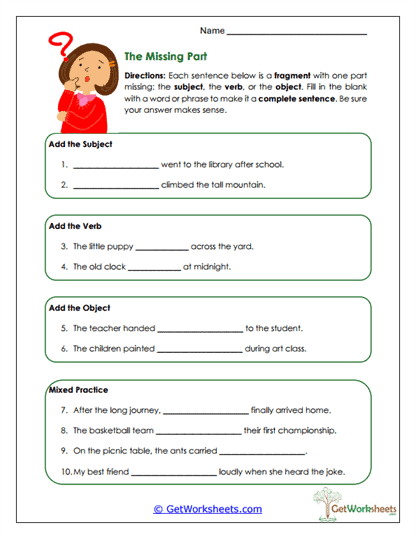
The Missing Part
Separate sections ask students to supply missing subjects, verbs, objects, or other necessary sentence elements. The focused format helps learners identify exactly what an incomplete sentence needs rather than adding random details. Context clues guide them toward logical and grammatically accurate answers. This worksheet reinforces how the main sentence parts work together to create complete meaning.
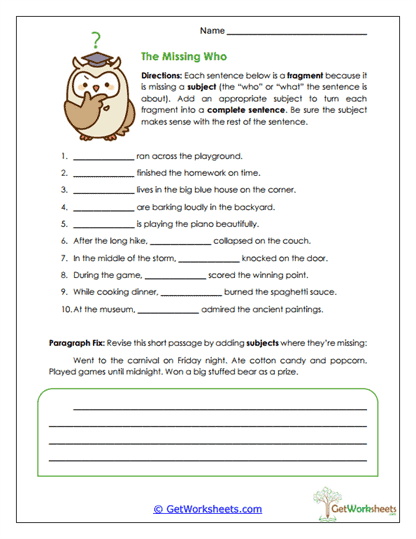
The Missing Who
Predicates that lack subjects must be rewritten as complete sentences. Students choose nouns or pronouns that logically perform each action and check that the subject agrees with the verb. A short passage extends the skill by asking learners to restore missing subjects throughout connected writing. The activity reinforces the basic question of who or what each sentence is about.
Bookmark Us Now!
New, high-quality worksheets are added every week! Do not miss out!