Clause-to-Clause Bridge
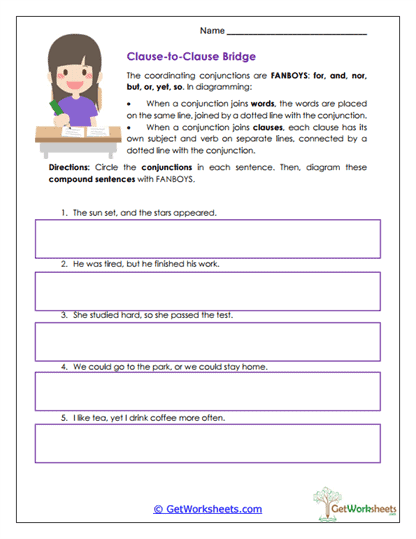
Clause-to-Clause Bridge teaches students how coordinating conjunctions connect two complete clauses in a compound sentence. Students first circle the conjunction, identify the subject and verb in each clause, and then diagram the clauses on separate main lines joined by a dotted bridge. The worksheet develops compound sentences, FANBOYS conjunctions, independent clauses, clause boundaries, sentence diagramming, punctuation, and grammatical relationships. It is a strong choice for students in grades 5-7 who need practice seeing why words such as and, but, or, yet, and so connect equal sentence parts.
Skills Reinforced
- Find the conjunction: Students locate the FANBOYS word joining the two clauses.
- Separate complete thoughts: Learners identify the subject and verb in each independent clause.
- Diagram both clauses: Students place each clause on its own main line.
- Build the connecting bridge: Children attach the clauses with a dotted line containing the conjunction.
Teaching Advantages
- Clarifies compound structure: Students can see that both clauses carry equal grammatical weight.
- Reinforces punctuation rules: The diagrams support understanding of the comma placed before a coordinating conjunction.
- Supports adult questioning: Parents can ask, “Can both sides of the conjunction stand alone as sentences?”
- Builds on earlier diagramming skills: Learners combine subject-verb analysis with clause-level structure.
- No-prep format: The worksheet is ready for classroom lessons, homework, tutoring, or homeschool practice.
Coordinating conjunctions act like bridges between two complete thoughts. In “The sun set, and the stars appeared,” each clause has its own subject and verb, while and shows how the ideas are connected. The diagram keeps the two clauses separate but links them with a dotted line, helping students understand both independence and connection. As learners work through the page, they strengthen clause recognition, conjunction knowledge, punctuation awareness, sentence analysis, diagramming fluency, and confidence. In classroom and homeschool settings, this practice reinforces the structure of compound sentences and prepares students to diagram longer sentences with multiple clauses.
Bookmark Us Now!
New, high-quality worksheets are added every week! Do not miss out!