Greater Guess
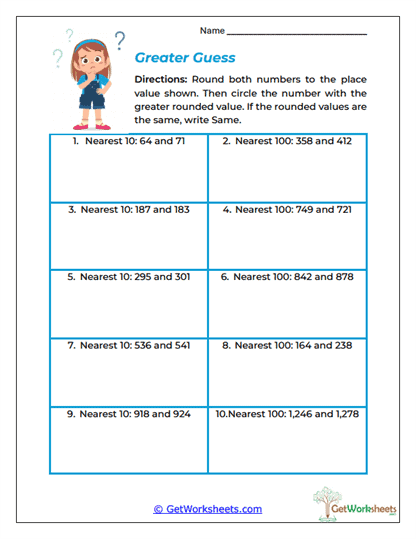
This worksheet turns rounding into a quick prediction game where students decide which number has the greater rounded value-or whether the two estimates are actually the same. Students round pairs of numbers to the nearest ten or hundred, then compare the resulting values and circle the number that produces the greater estimate. Along the way, they practice rounding, place value, comparison, estimation, number magnitude, equality, and number sense while learning that the larger original number does not always produce a different rounded answer. It is especially useful for grades 3-5 students who already know basic rounding and need practice thinking about how nearby numbers behave when they are rounded to the same benchmark.
Learning Goals
- Round Both Numbers Accurately: Students apply the same rounding place to each number before making any comparison.
- Identify the Greater Estimate: Learners decide which rounded value is larger after the approximation is complete.
- Recognize Equal Rounded Values: Students learn that two different original numbers can round to the same ten or hundred.
- Strengthen Number Relationships: Comparing estimates helps children think about distance from benchmarks and how close two numbers really are.
Classroom & Home Use
- Feels Like a Mini Guessing Game: Students make a comparison after rounding, which adds more purpose than simply writing isolated answers.
- Easy for Parents to Explain: Ask, “What does each number become, and which rounded number is bigger?”
- Builds Careful Thinking: Children must compare the rounded values rather than simply looking at which original number started larger.
- Helpful for Quick Assessment: Teachers can see whether students understand both the rounding step and the comparison step.
- Flexible for Practice: The worksheet works well for homework, centers, warm-ups, intervention, or homeschool lessons.
This worksheet is useful because it helps students see that rounding can change how numbers relate to one another. Place value, rounding, comparison, benchmark numbers, greater-than thinking, equality, estimation, and number sense all work together as students examine each pair. For parents, a useful point to emphasize is that numbers can start out different but still land on the same rounded value. That makes the activity more than a simple “which number is bigger?” exercise because students must actually complete the rounding before deciding. In classroom and homeschool settings, this practice builds stronger numerical reasoning and helps students become more confident comparing approximate values.
Bookmark Us Now!
New, high-quality worksheets are added every week! Do not miss out!