Power Check
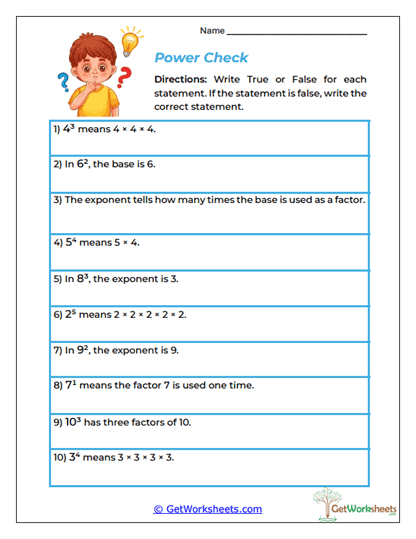
The Power Check Worksheet gives students a simple way to test whether they really understand what power notation means, not just how it looks. Students read each statement, decide whether it is true or false, and correct any statement that gives the wrong base, raised number, factor count, or repeated multiplication. This is a strong fit for grades 5-6 because it targets the exact misunderstandings students often have when they first learn powers, such as thinking the raised number is multiplied by the base or confusing which number is the base. By asking students to judge and correct statements, the worksheet builds understanding, accuracy, and mathematical language at the same time.
Learning Goals
- Identify Correct Meanings: Students decide whether a statement accurately describes a power expression.
- Correct Misconceptions: Learners rewrite false statements so the base, factor count, and repeated multiplication are represented correctly.
- Strengthen Vocabulary: Students reinforce words such as base, factor, power, and repeated multiplication.
- Explain Notation Clearly: The activity helps students understand what each part of the expression is actually telling them.
Instructional Benefits
- Great for Quick Checks: Teachers can use the page to see whether students understand the concept before moving to harder work.
- Targets Common Mistakes: The true-or-false format makes typical misunderstandings easy to spot and discuss.
- Parent-Friendly Practice: Families can ask, “What part of this sentence is wrong?” instead of needing to teach a whole new method.
- Low-Prep Review: The worksheet works well for warm-ups, homework, intervention, or homeschool practice.
Students strengthen their understanding of bases, powers, repeated factors, multiplication, factor counts, and mathematical statements by deciding what is correct and what needs to be fixed. This kind of practice is valuable because students must think about meaning, not just copy a procedure. In the classroom, teachers can use false statements as discussion starters and ask students to explain exactly what should change. At home, parents can encourage children to point to the base and then count how many times it should appear as a factor. That process builds comprehension, confidence, and attention to detail. It also gives students a stronger foundation for future work with larger powers and algebraic expressions.
Bookmark Us Now!
New, high-quality worksheets are added every week! Do not miss out!