Complex vs. Compound
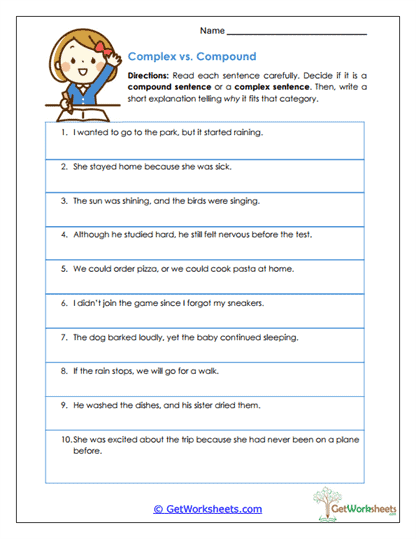
Complex vs. Compound helps students distinguish between sentences built with two independent clauses and sentences built with an independent clause plus a dependent clause. Students read each example, decide whether it is compound or complex, and write a brief explanation showing why the sentence belongs in that category. The worksheet strengthens clause analysis, coordinating conjunctions, subordinating conjunctions, independent clauses, dependent clauses, sentence classification, and grammatical reasoning. It is especially appropriate for students in grades 4-6 who have already learned both sentence types and now need practice comparing them directly.
Academic Focus
- Identify compound sentences: Students recognize two independent clauses joined by a coordinating conjunction.
- Identify complex sentences: Learners find one independent clause connected to at least one dependent clause.
- Use conjunction clues: Students distinguish FANBOYS words from subordinating conjunctions such as because, although, since, and if.
- Explain the classification: Children support their answer by referring to clause types and sentence structure.
Teaching Advantages
- Targets a common confusion: Students often mix up compound and complex sentences because both contain more than one idea.
- Requires explanation: Writing a reason shows whether learners truly understand the structure.
- Builds grammar vocabulary: The activity reinforces precise terms such as independent clause, dependent clause, coordinating conjunction, and subordinating conjunction.
- Works as review or assessment: The page fits classwork, homework, tutoring, test preparation, or homeschool instruction.
- Print-and-go design: No additional materials or preparation are needed.
The main difference between compound and complex sentences is the kind of clauses they contain. A compound sentence joins two complete thoughts, while a complex sentence combines one complete thought with a clause that cannot stand alone. A useful parent prompt is, “Can both parts be sentences by themselves, or does one part depend on the other?” As students classify and explain, they strengthen clause recognition, conjunction knowledge, sentence analysis, grammar vocabulary, reading comprehension, and confidence. In classroom and homeschool settings, this worksheet reinforces a deeper understanding of sentence structure and helps learners use a wider range of sentence patterns in their own writing.
Bookmark Us Now!
New, high-quality worksheets are added every week! Do not miss out!