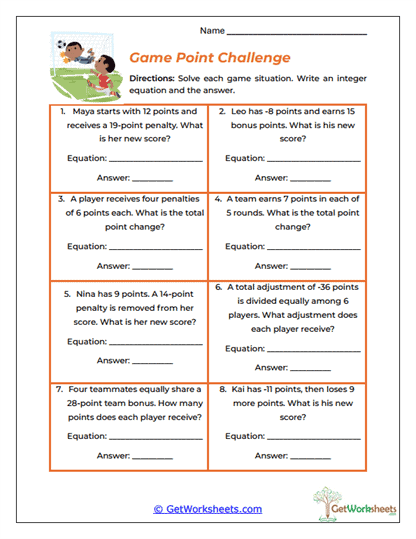
Game Point Challenge
This worksheet takes integer operations into a setting many students understand quickly: game scores and point changes. Instead of seeing a bare expression like 12 + (-19), students read a short situation first, decide which integer operation represents what happened, write the equation, and then solve it. Problems include earning bonus points, receiving penalties, losing points, sharing a point adjustment equally, and working with scores that are already below zero. That makes this worksheet especially useful because students have to understand the story before they can do the arithmetic. It strengthens integer addition, subtraction, multiplication, division, translating words into equations, and real-world problem solving.
For a parent who may not feel comfortable with negative numbers, game scores are a very natural way to explain them. Gaining points is usually positive. Losing points or receiving a penalty is negative. If a player starts with 12 points and receives a 19-point penalty, that can be written as 12 + (-19). The player loses more points than they originally had, so the final score drops below zero. Students can picture that much more easily than they can memorize a sign rule in isolation.
Learning Goals
- Translate Stories into Integer Equations: Students decide what operation and signs represent each game situation.
- Add and Subtract Score Changes: Learners work with bonuses, penalties, gains, and losses.
- Use Multiplication and Division: Some problems involve repeated penalties or sharing a total change equally.
- Interpret Negative Scores: Students become comfortable with the idea that a score can fall below zero.
- Connect Answers Back to the Story: Learners must decide what the numerical result means in the game situation.
Parent-Friendly Teaching Tips
- Start With the Story, Not the Rule: Ask, “Did the player gain points or lose points?”
- Translate Gains as Positive: Bonus points and points earned generally move the score upward.
- Translate Penalties as Negative: Losing points moves the score downward.
- Look for Groups: Repeated equal penalties may call for multiplication, while sharing a total adjustment may call for division.
- Check the Answer in Context: Ask, “Does this final score make sense based on what happened?”
Why This Worksheet Helps
- Makes Integers Feel Useful: Students see why positive and negative values are needed in real situations.
- Builds Word-Problem Confidence: The activity teaches children to pull mathematical information out of ordinary language.
- Uses All Four Operations: The student cannot assume every story is an addition problem.
- Supports Math Vocabulary: Words such as earns, penalty, loses, divided equally, and total change gain mathematical meaning.
- Prepares for Algebra: Turning a sentence into an equation is an important early algebra skill.
The real value of this worksheet is that it helps students understand that an integer expression is simply a short mathematical way to describe a situation. Scores, gains, losses, penalties, multiplication, division, positive integers, and negative integers all work together in each problem. For parents, a very useful question is: “What happened to the score-did it go up, go down, repeat, or get shared?” Once the child can answer that, choosing the operation becomes much easier. In classroom and homeschool settings, this worksheet is a strong bridge between integer rules and meaningful problem solving.
Bookmark Us Now!
New, high-quality worksheets are added every week! Do not miss out!