Estimate Pair Up
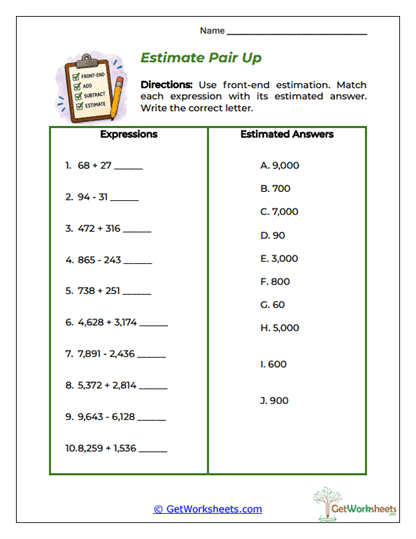
This worksheet turns front-end estimation into a matching challenge where students must connect each addition or subtraction expression with its approximate answer. Students strip each number down to its leading place value, complete the easier mental-math calculation, and then search the answer bank for the correct match. Because the page mixes addition and subtraction with numbers ranging from two digits into the thousands, students practice front-end estimation, place value, mental math, estimated sums, estimated differences, number magnitude, and matching skills without falling into a repetitive routine. It is especially useful for grades 4-5 students who understand the basic front-end method and are ready to use it more quickly and independently.
Learning Goals
- Create Front-End Values: Students identify the leading place of each number and replace the remaining digits with zeros.
- Estimate Sums and Differences: Learners use simplified values to solve both addition and subtraction expressions mentally.
- Match Answers Strategically: Students connect each original problem to the correct approximate result in the answer bank.
- Strengthen Number Magnitude: Working with tens, hundreds, and thousands helps students recognize the general size an answer should have.
Classroom & Home Use
- Adds a Puzzle Feel: The matching format makes practice feel more like finding connections than completing a plain list of calculations.
- Easy for Parents to Support: Ask, “What is the front-end value of each number, and which answer in the box matches?”
- Built-In Error Signal: If the estimate does not appear in the answer bank, students have a reason to check their place-value thinking or operation.
- Keeps Students Alert: Addition and subtraction are mixed together, so children have to notice the operation sign instead of working automatically.
- Flexible Practice: This worksheet works well for centers, homework, review, intervention, partner work, or homeschool lessons.
This worksheet helps front-end estimation become faster and more automatic without reducing it to mindless repetition. Leading digits, addition, subtraction, place value, mental computation, estimated sums, estimated differences, and number sense all work together as students hunt for the correct matches. For parents, the strategy is straightforward: simplify the numbers first, do the easier math, and then look for the answer that fits. The answer bank also gives children a useful way to notice when something has gone wrong without an adult immediately correcting them. In classroom and homeschool settings, this activity strengthens estimation fluency while giving students more confidence moving between different operations and different-sized numbers.
Bookmark Us Now!
New, high-quality worksheets are added every week! Do not miss out!