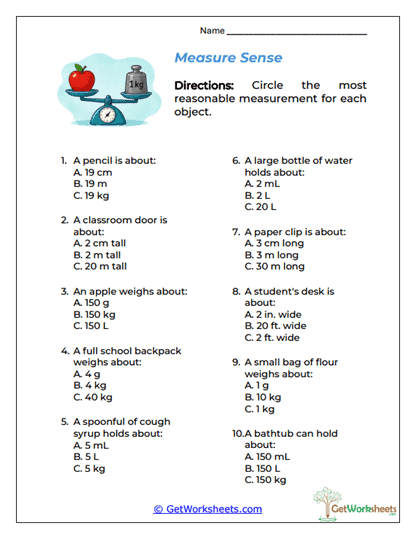
Measure Sense
This worksheet asks students to decide which measurement is believable for an everyday object, making it an excellent exercise in common sense as well as mathematics. Each problem gives three possible measurements for items such as a pencil, classroom door, apple, backpack, spoonful of medicine, water bottle, paper clip, desk, flour bag, and bathtub, and students circle the most reasonable choice. The activity blends estimation, measurement sense, centimeters, meters, grams, kilograms, milliliters, liters, magnitude, and real-world reasoning so students must think about both the number and the unit at the same time. It is especially useful for grades 3-5 students who know basic measurement units but still need practice recognizing when an answer is wildly too large, much too small, or just about right.
Targeted Skills
- Judge Reasonableness: Students decide whether a measurement makes sense for the size, weight, or capacity of a familiar object.
- Compare Units and Values Together: Learners must notice that both the number and the unit matter when deciding whether an answer is believable.
- Strengthen Measurement Benchmarks: Repeated comparisons help students develop mental reference points for common lengths, masses, and capacities.
- Use Everyday Knowledge in Math: Students connect what they know about pencils, doors, bottles, backpacks, and bathtubs to numerical measurements.
Instructional Benefits
- Great for Parent Talk: Adults can ask, “Can you picture a pencil that is 19 meters long?” to help a child reason through an unreasonable choice.
- Makes Wrong Answers Obvious on Purpose: Extreme choices encourage students to think about scale instead of relying on calculation.
- Supports Multiple Measurement Topics: Length, mass, and capacity all appear on the same page, giving students broad review.
- Builds Estimation Confidence: Students learn that they can often judge a measurement without needing to measure the object exactly.
- Easy No-Prep Practice: The worksheet works well for classwork, centers, homework, test review, intervention, or homeschool instruction.
The big idea behind this worksheet is that measurement should make sense in the real world, not just look correct on paper. Estimation, reasonable measurement, length, mass, capacity, metric units, magnitude, benchmarks, and number sense all work together as students choose the value that best fits each object. A child who knows that an apple is probably measured in grams rather than kilograms is developing the kind of practical thinking that makes later measurement work much easier. Parents can help by encouraging students to imagine holding, carrying, filling, or standing next to each object before selecting an answer. In classroom and homeschool settings, this activity builds stronger measurement intuition and helps students become more comfortable rejecting impossible or unrealistic values without needing an exact calculation.
Bookmark Us Now!
New, high-quality worksheets are added every week! Do not miss out!