Market Basket Math
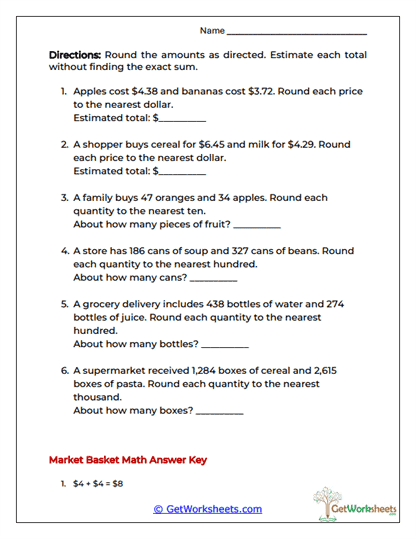
This worksheet helps students see how estimating sums can be useful in familiar shopping and grocery situations where a quick total is often more helpful than an exact calculation. Students read short real-world problems, round prices or quantities to the place value given, and then add the rounded amounts to estimate the total cost or number of items. The problems bring together addition, rounding, estimation, money math, place value, word-problem comprehension, and number sense while moving from simple dollar amounts to quantities in the hundreds and thousands. It is especially useful for grades 4-5 students who understand basic addition and rounding but need practice applying those skills to situations that feel more like everyday life.
Learning Goals
- Estimate Shopping Totals: Students round two amounts and add them to determine approximately how much something costs or how many items there are altogether.
- Round Different Types of Numbers: Learners work with prices rounded to the nearest dollar as well as larger quantities rounded to tens, hundreds, and thousands.
- Interpret Addition Word Problems: Students identify the two amounts that need to be combined before deciding how to estimate.
- Connect Math to Daily Life: Grocery prices, fruit, canned goods, drinks, and store inventory show students why quick addition estimates can be useful outside school.
Classroom & Home Use
- Easy for Parents to Explain: Families can ask, “About how much is each amount, and about how much will they make together?”
- Builds Practical Money Sense: Early problems show students how rounding prices can help someone quickly predict a shopping total.
- Includes Larger Quantities: Later problems extend the same estimation strategy to hundreds and thousands of grocery items.
- Strengthens Reading and Math Together: Students must understand what is being asked before they can round and add correctly.
- Ready for Many Settings: The worksheet works well for homework, independent practice, centers, review, intervention, or homeschool lessons.
This worksheet is valuable because students get to use estimation in situations that are easy to understand and easy for a parent to talk about. Addition, rounding, money, estimated sums, place value, quantities, mental math, and word-problem reasoning all work together as students figure out an approximate total. A child does not always need to know the exact number of bottles in a delivery or the exact grocery bill to make a useful decision; sometimes knowing that the total is about 700 or about $10 is enough. That is the practical purpose behind estimation, and these problems help make that purpose clearer. In classroom and homeschool settings, the worksheet can strengthen addition confidence while showing students that rounding and estimation are useful tools for shopping, budgeting, inventory, and everyday decision-making.
Bookmark Us Now!
New, high-quality worksheets are added every week! Do not miss out!