Benchmark Battle
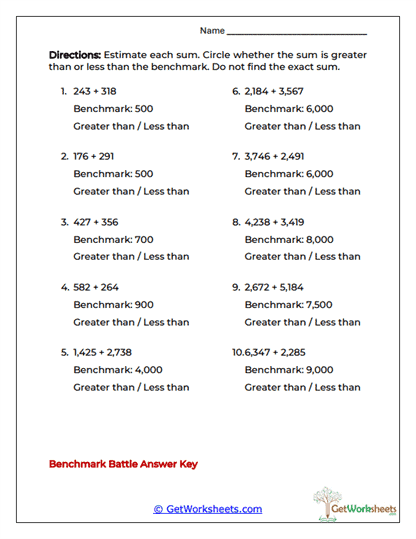
This worksheet helps students estimate addition problems and then compare each approximate total with a benchmark number. Students are not asked to find the exact sum; instead, they use rounding, addition, estimation, place value, mental math, number sense, and comparison skills to decide whether the sum should be greater than or less than the given benchmark. That makes the activity especially useful because students must understand the general size of a total rather than rely on exact written computation. It is well suited to grades 4-5 students who know how to estimate sums and are ready to use those estimates to make quick mathematical judgments.
Academic Focus
- Estimate Before Comparing: Students simplify the addends mentally to determine approximately what each total should be.
- Use Benchmark Numbers: Learners compare their estimated sum with targets such as 500, 4,000, 6,000, or 9,000.
- Judge Greater or Less Than: Students use their estimate to decide which side of the benchmark the sum should fall on.
- Strengthen Number Magnitude: The activity helps children understand whether a total belongs in the hundreds, thousands, or several thousands without calculating exactly.
Educational Value
- Easy for Parents to Explain: A parent can ask, “About what do these numbers add to, and is that total above or below the benchmark?”
- Encourages Efficient Thinking: Students learn that they can answer some math questions without performing full addition.
- Builds Number Sense: Comparing with a target strengthens the child’s understanding of how large a sum should be.
- Supports Self-Checking: Benchmark thinking can later help students recognize exact addition answers that are far outside a reasonable range.
- Useful Across Settings: The worksheet fits well into warm-ups, homework, centers, review, intervention, enrichment, or homeschool practice.
This worksheet helps students understand that estimating a sum can be useful even when nobody asks for an exact answer. Addition, rounding, benchmark numbers, comparison, place value, estimated sums, mental computation, and number sense all work together as students decide whether a total is above or below a target. For parents, the idea is similar to asking whether a shopping total will probably be more or less than a certain budget without adding every item to the penny. Students begin learning to make quick but informed numerical decisions based on the size of the addends. In classroom and homeschool settings, this type of practice strengthens estimation fluency, comparison skills, and confidence while helping children see addition as something they can reason about-not just a procedure they perform.
Bookmark Us Now!
New, high-quality worksheets are added every week! Do not miss out!