Shopping Estimates
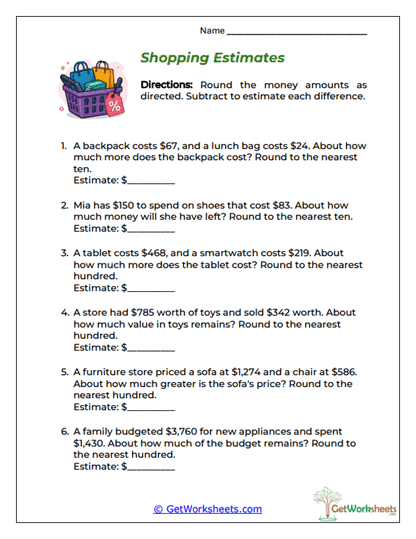
This worksheet brings estimating differences into familiar shopping situations so students can see why subtraction estimation matters outside of a math lesson. Each word problem compares two prices, amounts spent, values, or budgets, and students round the money amounts as directed before subtracting to estimate how much more or how much remains. Along the way, students practice subtraction, rounding, estimation, money math, place value, word-problem comprehension, and number sense while working with situations that feel more connected to everyday life. The activity is well suited to grades 4-5 students who are ready to apply estimation skills to practical problems involving dollars and larger whole-number amounts.
Academic Focus
- Estimate Money Differences: Students round dollar amounts and subtract to find an approximate difference rather than calculating every value exactly.
- Interpret Word Problems: Learners must decide what is being compared before they can perform the subtraction.
- Use Place Value in Context: Problems require rounding to tens, hundreds, or thousands depending on the size of the numbers.
- Connect Math to Everyday Decisions: Shopping, spending, budgets, and prices help students see how estimation can be useful in real situations.
Educational Value
- Relatable for Students: Backpacks, shoes, electronics, toys, furniture, and family budgets provide situations children can understand more easily than abstract number pairs.
- Parent-Friendly Practice: Families can talk through the problems using everyday language such as, “About how much more does this cost?”
- Builds Reading and Math Together: Students must understand the situation before deciding which numbers should be subtracted.
- Supports Practical Number Sense: The activity helps children become more comfortable estimating prices and differences without needing an exact total.
- Flexible and No-Prep: It can be used for homework, independent practice, math centers, life-skills connections, intervention, or homeschool instruction.
The real strength of this worksheet is that students get to see estimation as something people actually use when making everyday decisions. Rounding, subtraction, money, budgeting, place value, word-problem solving, estimation, and number sense all work together as students decide approximately how much more something costs or how much money remains. A shopper often does not need an answer down to the exact dollar before deciding whether one item costs hundreds more than another, and this activity helps children understand that idea. These problems also encourage students to read carefully because phrases such as “how much more,” “how much remains,” and “how much greater” all signal a subtraction relationship. Whether used at school or at home, the worksheet helps turn estimation from an isolated classroom skill into a practical tool students can understand and use with confidence.
Bookmark Us Now!
New, high-quality worksheets are added every week! Do not miss out!