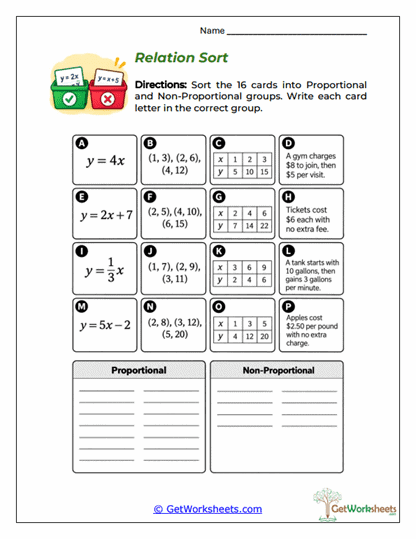
Relation Sort
This worksheet gives students a mixed collection of relationship cards and asks them to sort each one into Proportional or Non-Proportional. The cards include equations, ordered pairs, tables, and short real-world situations. That makes this one of the stronger review worksheets in the set because students have to recognize proportionality across several different representations instead of relying on just one type of clue.
For a parent, the easiest way to support the child is to use a different test depending on the format. For an equation, look for y = kx. For a table or ordered pairs, check whether y/x stays constant. For a real-world situation, look for a starting fee or initial amount. Each card is asking the same basic question in a different form: does y stay in the same multiplicative relationship with x?
Key Learning Objectives
- Classify Multiple Representations: Students identify proportionality in equations, tables, ordered pairs, and situations.
- Choose the Right Test: Learners apply the correct method for each representation.
- Connect Different Forms: Students understand that the same relationship can be shown in several ways.
- Strengthen Conceptual Flexibility: Learners move between symbolic, numeric, and contextual information.
- Build Review Fluency: Students apply several proportionality rules in one activity.
Parent-Friendly Explanation
Use these quick checks:
- Equation: Does it look like y = kx?
- Table: Is y/x always the same?
- Ordered pairs: Is y the same multiple of x each time?
- Situation: Is there a starting amount before the regular rate begins?
For example:
y = 4x → Proportional
y = 2x + 7 → Non-Proportional
Tickets cost $6 each with no extra fee → Proportional
A gym charges $8 to join, then $5 per visit → Non-Proportional
Why This Worksheet Helps
- Builds Transfer Between Formats: Students learn the idea instead of memorizing one procedure.
- Strengthens Test Readiness: Mixed representations are common on middle-school assessments.
- Encourages Comparison: Sorting helps students see what proportional relationships have in common.
- Supports Algebra and Graphing: Students connect equations and data with real situations.
- Reveals Misconceptions: A student may understand tables but struggle with equations, and this worksheet makes that visible.
The real value of this worksheet is that it helps students recognize proportional relationships no matter how they are shown. Equations, ordered pairs, tables, real-world situations, constant ratios, and starting values all connect. For parents, the best coaching question is: “What clue does this format give us?”
Bookmark Us Now!
New, high-quality worksheets are added every week! Do not miss out!