Probability Repair
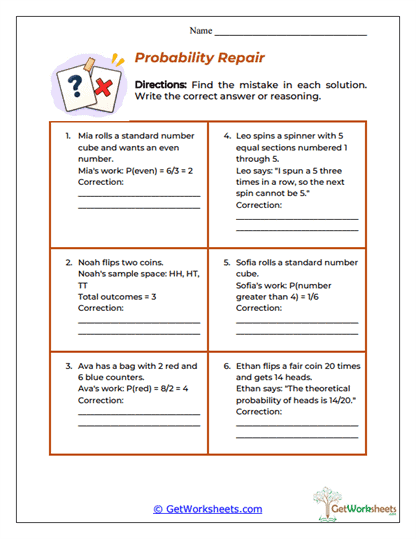
Evaluating incorrect probability calculations helps students strengthen their understanding of mathematical reasoning while learning to recognize common misconceptions about chance. This investigative statistics activity for Grades 5-7 presents six scenarios involving number cubes, coin flips, colored counters, and numbered spinners, each accompanied by a student’s incorrect calculation or conclusion. Learners examine the proposed solution, identify the mistake, and write the correct probability, explanation, or sample space using appropriate mathematical evidence. Through these exercises, students develop error-analysis skills, theoretical probability understanding, experimental probability interpretation, outcome counting, fraction reasoning, and an appreciation of independence in random events.
Academic Focus
-
Correcting Probability Fractions: Recognize when favorable outcomes and total possible outcomes have been reversed or counted incorrectly.
-
Identifying Complete Sample Spaces: Determine whether all possible outcomes have been included in experiments involving multiple coin flips.
-
Understanding Independent Events: Recognize that previous results do not determine the outcome of a new independent spin or coin flip.
-
Distinguishing Probability Types: Explain the difference between theoretical probabilities based on equally likely outcomes and experimental probabilities based on observed trials.
Teaching Advantages
-
Six Error-Analysis Challenges: Provides opportunities to investigate different misconceptions involving calculations, sample spaces, and chance predictions.
-
Critical Thinking Development: Encourages students to evaluate mathematical reasoning instead of relying exclusively on memorized formulas.
-
Written Correction Practice: Dedicated answer spaces support mathematical explanations and accurate communication of probability concepts.
-
Misconception-Based Instruction: Helps teachers identify misunderstandings about independent events, favorable outcomes, and theoretical versus experimental probability.
-
Flexible Classroom Use: Suitable for small-group investigations, partner discussions, independent assessments, and homeschool enrichment.
Recognizing mistakes in probability reasoning helps learners become more confident and thoughtful mathematical problem-solvers. By examining incorrect fractions, incomplete sample spaces, misleading predictions, and confusion between experimental and theoretical results, students strengthen conceptual understanding and statistical literacy. Teachers can extend the activity by asking learners to explain why an incorrect approach seems reasonable at first and demonstrate the mathematical principle that corrects it. This printable reinforces accuracy, logical reasoning, probability vocabulary, and independent thinking while preparing students to analyze more challenging random experiments and evaluate statistical claims.
Bookmark Us Now!
New, high-quality worksheets are added every week! Do not miss out!