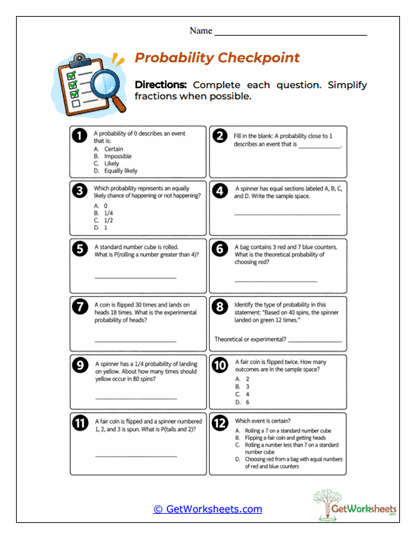
Probability Checkpoint
Assessing students’ understanding of probability concepts helps determine whether they can accurately describe likelihood, calculate numerical probabilities, and interpret random experiments. This comprehensive statistics review for Grades 5-7 presents twelve questions covering probability vocabulary, numerical scales, sample spaces, theoretical probability, experimental probability, expected outcomes, and compound events. Learners complete multiple-choice questions, short-answer problems, and numerical calculations involving coins, number cubes, spinners, and colored counters while demonstrating their ability to connect different probability concepts. The activity reinforces favorable outcome counting, fraction simplification, event classification, statistical reasoning, mathematical communication, and the interpretation of chance across familiar situations.
Skills Reinforced
-
Understanding Probability Language: Recognize the meanings of impossible, unlikely, equally likely, likely, and certain events within numerical and descriptive contexts.
-
Calculating Event Probabilities: Determine theoretical and experimental probabilities using favorable outcomes, total possibilities, and recorded trial results.
-
Analyzing Sample Spaces: Identify all possible outcomes of simple and compound experiments, including multiple coin flips and spinner combinations.
-
Applying Probability Predictions: Use fractional likelihoods to estimate expected outcomes and distinguish between mathematical expectations and observed results.
Instructional Support
-
Twelve Comprehensive Questions: Reviews essential probability concepts through a balanced combination of vocabulary, calculations, and mathematical reasoning.
-
Multiple Response Formats: Includes multiple-choice questions, short written answers, and numerical exercises to assess different learning objectives.
-
Diagnostic Assessment: Helps teachers identify misconceptions involving sample spaces, probability fractions, and theoretical versus experimental results.
-
Cumulative Skill Review: Connects introductory likelihood concepts with more advanced probability applications in one organized activity.
-
Print-and-Go Convenience: Suitable for end-of-unit assessments, classroom review, homework, intervention activities, and homeschool mathematics instruction.
Reviewing probability concepts together helps students recognize how different mathematical ideas contribute to understanding random events. Through likelihood classification, probability calculations, outcome enumeration, fractional reasoning, and statistical predictions, learners demonstrate their understanding of essential chance-related skills. Teachers can use the results to evaluate student progress, address misconceptions, and determine readiness for more challenging probability investigations. This comprehensive printable strengthens mathematical fluency, analytical confidence, critical thinking, and independent problem-solving while reinforcing the foundational knowledge needed for continued learning in statistics, data analysis, and compound probability.
Bookmark Us Now!
New, high-quality worksheets are added every week! Do not miss out!