Price Watch
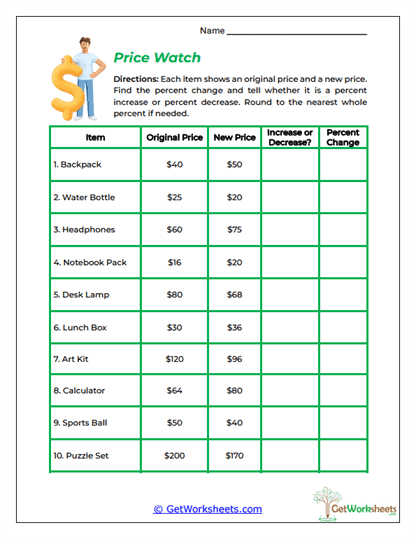
This worksheet brings percent change into shopping by asking students to compare original prices with new prices and determine how much each item increased or decreased in percentage terms. Students work with familiar items such as backpacks, water bottles, headphones, notebook packs, desk lamps, lunch boxes, art kits, calculators, sports balls, and puzzle sets. They first decide whether the price went up or down, then find the amount of change and compare that difference with the original price. The activity strengthens percent increase, percent decrease, money math, subtraction, division, decimal conversion, and financial number sense while showing students why percent change is useful when comparing price movements. It is especially useful for grades 6-7 students who are ready to connect percentage skills with real-world financial situations.
Key Learning Objectives
- Find the Price Difference: Students subtract the original and new prices to determine how much the price changed.
- Identify Increase or Decrease: Learners decide whether the customer would now pay more or less than before.
- Calculate Percent Change: Students divide the price difference by the original price and convert the result to a percent.
- Interpret Financial Meaning: Learners understand what a 20% increase or 15% decrease actually says about the price.
Educational Value
- Makes Percent Change Practical: Price changes are one of the clearest everyday examples of why percentages matter.
- Parent-Friendly Discussion: Ask, “How many dollars did the price change, and what percent of the old price is that?”
- Builds Financial Literacy: The worksheet creates a foundation for later work with sales, inflation, discounts, markups, and budgets.
- Encourages Reasonableness: Students can often predict whether the percent should be small or large before calculating.
- Works Across Settings: It fits well into homework, financial-math lessons, centers, review, or homeschool practice.
This worksheet helps students connect percent change with the way prices move in everyday life. Original price, new price, dollar difference, percent increase, percent decrease, division, and financial reasoning all work together as students analyze each item. For parents, a backpack changing from $40 to $50 is a useful example: the price increased by $10, and $10 is 25% of the original $40, so the price rose by 25%. That distinction matters because the percentage describes the size of the change compared with the old price, not the new one. In classroom and homeschool settings, this activity builds percent fluency while strengthening practical money sense.
Bookmark Us Now!
New, high-quality worksheets are added every week! Do not miss out!