Outcome Organizer
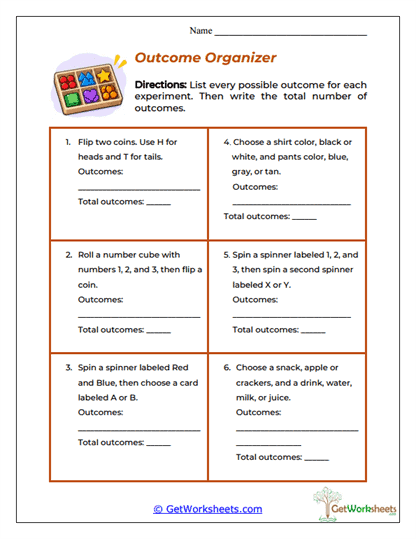
Understanding all the possible results of a random experiment is an essential foundation for calculating probability accurately. Designed for students in Grades 4-6, this structured statistics activity presents six experiments involving coin flips, number cubes, colored spinners, lettered cards, clothing choices, and snack-and-drink combinations. Students systematically list every possible outcome for each experiment and determine the total number of outcomes represented in the complete sample space. Through these exercises, learners strengthen systematic counting, sample space organization, outcome enumeration, combinations, probability reasoning, and their ability to analyze multistage events without overlooking possible results.
Targeted Skills
-
Identifying Sample Spaces: Recognize that a sample space contains every possible outcome of a random experiment.
-
Listing Combined Outcomes: Organize the results of experiments involving two sequential actions, such as rolling a number cube and flipping a coin.
-
Counting Possible Combinations: Determine the total number of outcomes when different choices or experimental stages are combined.
-
Applying Systematic Strategies: Use organized lists, tables, or patterns to avoid missing outcomes or counting the same result more than once.
Teaching Advantages
-
Six Varied Experiments: Provides meaningful examples involving everyday choices and familiar probability tools.
-
Foundational Compound Probability: Introduces the structure of multistage experiments before students calculate the probabilities of combined events.
-
Organizational Skill Development: Encourages careful recording, logical sequencing, and complete enumeration of possible results.
-
Real-World Applications: Clothing combinations and snack selections demonstrate how systematic counting extends beyond games of chance.
-
Classroom Flexibility: Suitable for guided instruction, collaborative activities, independent practice, enrichment lessons, and homeschool learning.
Listing sample spaces helps students recognize why identifying all possible outcomes is necessary before determining the probability of an event. Through organized counting, outcome enumeration, combination analysis, and multistage reasoning, learners develop stronger mathematical accuracy and analytical confidence. Teachers can extend the activity by introducing tree diagrams or the fundamental counting principle as alternative strategies for finding the total number of outcomes. This printable reinforces logical organization, mathematical communication, systematic problem-solving, and introductory probability concepts while preparing students for compound probability calculations, independent events, and more advanced counting methods.
Bookmark Us Now!
New, high-quality worksheets are added every week! Do not miss out!