Mode Sort
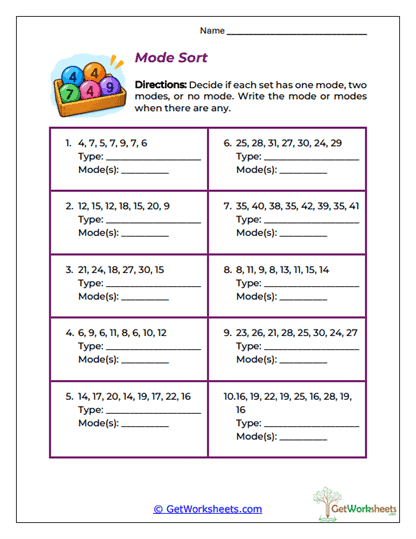
Not every collection of numerical data has a single most frequently occurring value, making mode classification an important part of statistical understanding. This thought-provoking printable for Grades 4-6 challenges students to examine ten numerical data sets and determine whether each collection has one mode, two modes, or no mode. Learners analyze repeated observations, compare numerical frequencies, identify values sharing the highest frequency, and record the appropriate classification along with any existing modes. Through these exercises, students strengthen frequency analysis, pattern recognition, numerical comparisons, statistical classification, and critical thinking while developing a deeper understanding of how different distributions can contain varying numbers of modes.
Academic Focus
-
Recognizing Unimodal Data: Identify collections containing one value that occurs more frequently than all others.
-
Identifying Bimodal Distributions: Recognize when two distinct values share the greatest frequency and record both modes.
-
Understanding No Mode: Determine when every value occurs equally often and no particular observation is more frequent than the others.
-
Classifying Numerical Data: Analyze frequency patterns to distinguish between different types of data sets accurately.
Instructional Benefits
-
Ten Classification Exercises: Provides repeated opportunities to evaluate numerical distributions with different repetition patterns.
-
Deeper Conceptual Understanding: Moves beyond finding a single mode by introducing multiple modes and distributions without a mode.
-
Two-Part Response Format: Separate spaces for classification and mode values encourage complete mathematical explanations.
-
Critical Thinking Practice: Requires students to compare frequencies carefully rather than assume every data set has one mode.
-
Versatile Classroom Application: Useful for guided instruction, small-group activities, independent assignments, formative assessment, and homeschool practice.
Understanding the different possibilities for mode helps students interpret numerical data with greater accuracy and flexibility. By examining repeated observations, comparing frequencies, recognizing bimodal patterns, and identifying distributions without a mode, learners strengthen mathematical reasoning and statistical comprehension. Teachers can extend the activity by asking students to construct their own examples of unimodal, bimodal, and no-mode data sets or explain why a classification is correct. This print-and-go resource encourages careful analysis, independent thinking, mathematical communication, and confidence while preparing students for advanced discussions about frequency distributions, multimodal data, and measures of central tendency.
Bookmark Us Now!
New, high-quality worksheets are added every week! Do not miss out!