Missing Percentage
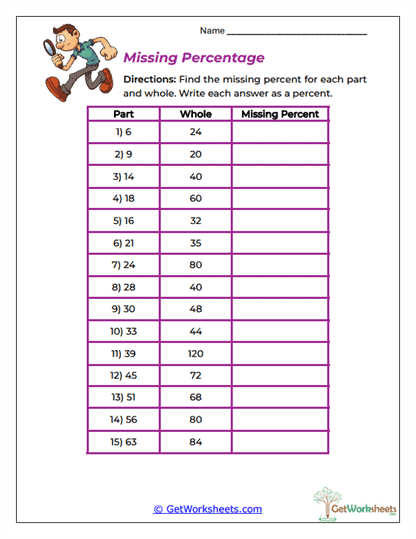
This worksheet gives students a clean table of part-and-whole pairs and asks them to calculate the missing percentage for each row. Students work with examples such as 6 out of 24, 9 out of 20, 14 out of 40, 24 out of 80, 45 out of 72, and 63 out of 84, repeatedly using part ÷ whole × 100 to complete the final column. The organized format strengthens percent calculation, fraction simplification, division, decimal conversion, number sense, and table reading while giving students enough repetition to make the process feel dependable and familiar. It is especially useful for grades 5-6 students who are building fluency with percent problems and need straightforward practice before moving into more complicated word problems.
Key Learning Objectives
- Find the Missing Percent: Students calculate what percentage the part represents of the whole.
- Use a Consistent Formula: Learners repeatedly apply part ÷ whole × 100 across many examples.
- Recognize Common Fraction Relationships: Pairs such as 9/20, 21/35, and 56/80 help students connect fractions to familiar percents.
- Strengthen Table Organization: Students practice reading across columns without mixing up the part and whole.
Educational Value
- Simple for Parents to Explain: Use the routine, “Divide the part by the total, then turn the decimal into a percent.”
- Builds Fluency Through Repetition: The consistent layout helps students focus on accuracy and speed.
- Useful for Mental Math Practice: Several rows simplify to common fractions that students may be able to convert without a calculator.
- Helps Reveal Mix-Ups: Teachers can easily spot whether a child is accidentally dividing the whole by the part.
- Flexible for School or Home: The worksheet works well for homework, centers, intervention, review, or homeschool practice.
The strength of this worksheet is that it gives students enough repetition to make the percent process feel automatic without making the numbers meaningless. Part, whole, division, fractions, decimals, percent conversion, and number sense all work together as students complete each row. For parents, a problem such as 24 out of 80 can be simplified to 3 out of 10, making 30% much easier to understand. That kind of flexible thinking helps students move beyond a formula and start recognizing common percentage relationships. In classroom and homeschool settings, this activity builds the fluency students need for later work with grades, discounts, statistics, probability, and financial math.
Bookmark Us Now!
New, high-quality worksheets are added every week! Do not miss out!