Frequency Fill
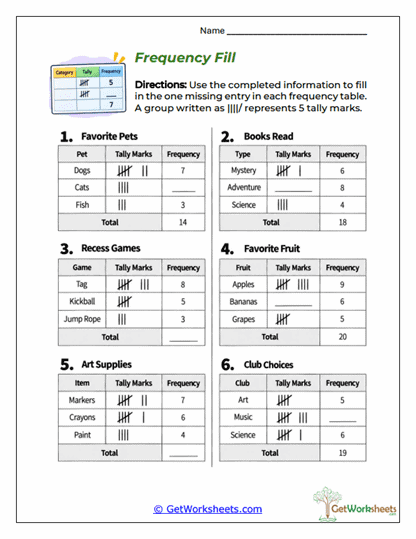
This Frequency Fill Worksheet helps students in Grades 3-5 develop practical statistics skills by completing missing information in frequency tables. Students examine six themed data sets involving favorite pets, books read, recess games, favorite fruit, art supplies, and club choices. Each activity requires learners to interpret tally marks, calculate numerical frequencies, identify missing values, or determine totals while applying their knowledge of data organization and statistical relationships. Through these exercises, students strengthen their understanding of categorical data, tally notation, frequency distributions, arithmetic calculations, and table interpretation.
Instructional Objectives
-
Completing Frequency Tables: Identify missing tally marks, frequency values, and totals using the information provided.
-
Interpreting Tally Groups: Read tally marks organized in groups of five and convert them into numerical quantities.
-
Calculating Missing Values: Use addition and subtraction to determine unknown frequencies and category totals.
-
Analyzing Statistical Relationships: Understand how individual frequencies contribute to the overall number of observations.
Classroom & Home Use
-
Six Varied Activities: Multiple real-world categories provide repeated exposure to different frequency table arrangements.
-
Scaffolded Practice: Partially completed tables allow students to focus on missing information without constructing entire tables.
-
Curriculum Connection: Reinforces elementary statistics, numerical operations, and data interpretation objectives.
-
Flexible Instruction: Appropriate for classroom review, independent assignments, math centers, homework, and homeschool instruction.
This printable frequency table worksheet encourages learners to approach statistical information with accuracy and logical reasoning. By completing missing tally marks, calculating frequencies, verifying totals, and interpreting categorical data, students develop essential mathematical problem-solving skills. Teachers can use the six exercises to assess understanding of frequency distributions and identify students who need additional practice with tally notation or arithmetic reasoning. Regular exposure to partially completed data tables builds confidence, strengthens comprehension, and prepares students for more advanced topics such as bar graphs, surveys, data comparisons, and statistical analysis.
Bookmark Us Now!
New, high-quality worksheets are added every week! Do not miss out!