Best Measure
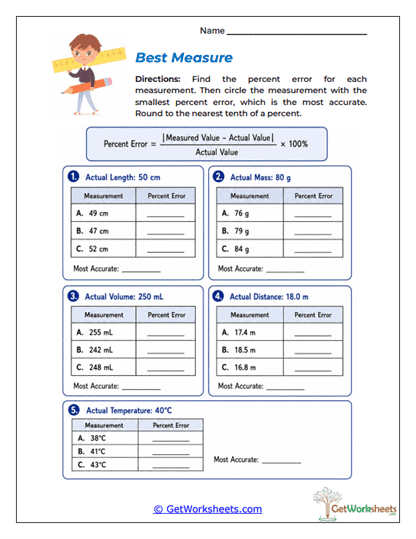
This worksheet asks students to calculate the percent error for several possible measurements of the same actual value, then choose which measurement is the most accurate. Students work with examples involving length, mass, volume, distance, and temperature, comparing choices such as 49 cm, 47 cm, and 52 cm against an actual length of 50 cm. The activity strengthens percent error, comparison, absolute difference, division, rounding, measurement sense, and decision-making while reinforcing the idea that the measurement with the smallest percent error is the most accurate. It is especially useful for grades 6-8 students who understand how to calculate percent error and are ready to compare multiple measurements rather than evaluating just one.
Learning Goals
- Calculate Several Percent Errors: Students find the error percentage for multiple measurements tied to the same actual value.
- Compare Accuracy: Learners identify which measurement is closest to the actual value in percentage terms.
- Use Smallest Error as the Guide: Students understand that lower percent error means greater accuracy.
- Work Across Measurement Types: Problems include length, mass, volume, distance, and temperature.
Classroom & Home Use
- Easy for Parents to Explain: Ask, “Which measurement missed the actual value by the smallest percentage?”
- Builds Comparison Skills: Students do more than calculate; they must interpret and rank the results.
- Supports Science Connections: Comparing measurements is a natural part of experiments and repeated trials.
- Encourages Estimation First: Students can often predict which measurement will be most accurate before completing the exact math.
- Great for Review or Enrichment: The worksheet works well for centers, STEM practice, homework, or homeschool lessons.
This worksheet helps students see that percent error is especially useful when comparing the quality of different measurements. Actual values, measured values, absolute error, percent error, comparison, and accuracy all work together as students decide which result is best. For parents, the core idea is simple: the closer a measurement is to the true value, the smaller its percent error should be. In classroom and homeschool settings, this activity builds stronger measurement judgment and helps students connect percent error with the broader idea of precision and accuracy.
Bookmark Us Now!
New, high-quality worksheets are added every week! Do not miss out!