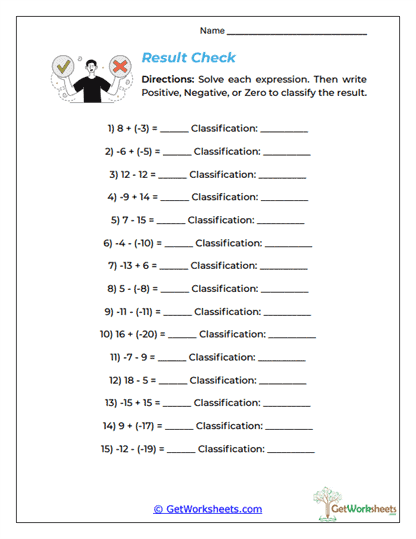
Result Check
This worksheet asks students to solve a variety of integer expressions and then classify each result as Positive, Negative, or Zero. Problems include both addition and subtraction, with examples such as 8 + (-3), -6 + (-5), 12 – 12, -13 + 6, 16 + (-20), and -15 + 15. That mix gives students practice using several integer rules at once while also requiring them to think about the sign of the final answer. The classification step is important because it pushes students to understand what the result means instead of simply writing a number and moving on.
For a parent, this worksheet is a nice way to see whether a child is developing real number sense. A student may make an arithmetic slip, but if they correctly predict that an answer should be negative, that shows part of the reasoning is in place. Likewise, if two opposite numbers such as -15 and 15 are combined, the student should recognize that they cancel to zero. That kind of thinking helps children catch their own mistakes before an adult has to point them out.
Key Learning Objectives
- Solve Mixed Integer Expressions: Students practice both addition and subtraction with positive and negative values.
- Classify the Final Result: Learners label each answer as positive, negative, or zero.
- Recognize Cancellation: Opposite integers can combine to make zero.
- Strengthen Sign Prediction: Students learn to anticipate the type of answer before or after calculating.
- Apply Multiple Integer Rules: The page mixes same-sign, opposite-sign, and subtraction situations.
Why This Worksheet Helps
- It Adds a Second Layer of Thinking: Students are not finished when they calculate; they must also interpret the answer.
- It Makes Errors Easier to Catch: If a child gets a positive result from a situation that should clearly be negative, the classification exposes the problem.
- It Builds Number Sense: Students begin noticing patterns in the way positive and negative quantities interact.
- It Encourages Mental Checking: Learners can often predict the sign before doing the exact arithmetic.
- It Works Well for Review: The mixed format makes the worksheet a strong checkpoint after several integer lessons.
Parent-Friendly Explanation
A useful question is: “Before you solve it, what kind of answer do you expect-positive, negative, or zero?” For example, -13 + 6 should still be negative because the negative side has the greater magnitude. On the other hand, -15 + 15 should be zero because the numbers are exact opposites. That prediction gives the child a target and makes it easier to spot a wrong final answer.
This worksheet is valuable because it teaches students to connect the answer with its sign and meaning. Addition, subtraction, zero, positive values, negative values, absolute value, and classification all work together as students complete each problem. For parents, the classification step gives a very simple way to discuss the work even if the arithmetic itself feels rusty. In classroom and homeschool settings, this activity builds stronger integer fluency and helps students become more independent checkers of their own work.
Bookmark Us Now!
New, high-quality worksheets are added every week! Do not miss out!