Opposite Chance
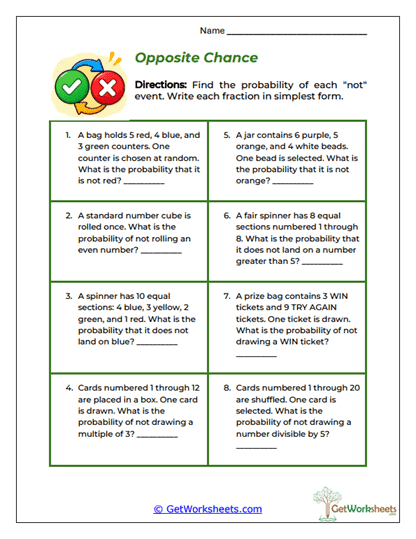
Understanding the probability of an event not occurring is an important step toward developing more flexible mathematical reasoning about chance. This thought-provoking statistics activity for Grades 4-6 presents eight word problems involving colored counters, standard number cubes, numbered spinners, prize tickets, and card selections. Students investigate situations that ask for the probability of not selecting a certain color, not rolling a particular type of number, or not obtaining a specified result. The exercises reinforce complementary probability, favorable outcome counting, fraction simplification, sample space interpretation, numerical comparisons, and logical reasoning while helping learners recognize the relationship between an event and its opposite.
Skills Reinforced
-
Understanding Complementary Events: Recognize that the complement of an event includes every possible outcome in which the original event does not occur.
-
Calculating Opposite Probabilities: Identify outcomes that satisfy conditions involving phrases such as “not red,” “not even,” or “not divisible by 5.”
-
Applying the Complement Rule: Understand that the probability of an event not occurring equals one minus the probability of that event occurring.
-
Simplifying Fractional Answers: Calculate probabilities using favorable and total outcomes, then reduce fractions to their simplest forms.
Educational Value
-
Eight Complementary Probability Problems: Provides targeted practice with the concept of events not occurring across familiar random experiments.
-
Conceptual Statistics Development: Helps students understand that an event and its complement account for all possible outcomes.
-
Number Sense Connections: Reinforces even numbers, divisibility, numerical inequalities, and fraction relationships.
-
Multiple Solution Strategies: Encourages learners to compare direct outcome counting with subtracting an event’s probability from one.
-
Versatile Instructional Applications: Suitable for guided lessons, partner activities, independent practice, enrichment exercises, and homeschool mathematics.
Exploring complementary probability helps students develop a more complete understanding of how possible outcomes are related. Through event classification, fraction calculations, numerical reasoning, and the complement rule, learners strengthen statistical comprehension and mathematical flexibility. Teachers can extend the activity by asking students to calculate both an event’s probability and its complement, then verify that the two probabilities add to one. This printable promotes logical thinking, computational accuracy, probability vocabulary, and independent problem-solving while preparing students to analyze more complex random experiments, combined events, and advanced probability relationships.
Bookmark Us Now!
New, high-quality worksheets are added every week! Do not miss out!