Double Chance
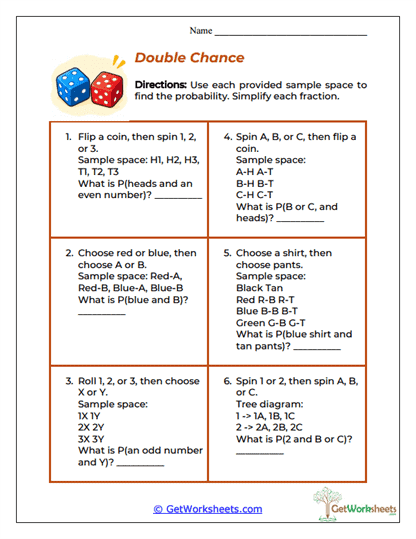
Understanding how two successive actions create a combined outcome is an essential foundation for learning compound probability. This structured printable for Grades 5-7 presents six experiments involving combinations of coin flips, numbered spinners, lettered choices, clothing selections, and other multistage probability situations. Students examine the provided sample spaces or tree diagram, identify the outcomes that satisfy particular conditions, and express the probability of each compound event as a simplified fraction. The exercises strengthen compound probability, systematic counting, favorable outcome identification, sample space interpretation, fraction simplification, and mathematical reasoning while introducing students to the relationships between multiple random choices.
Targeted Skills
-
Interpreting Compound Events: Recognize that an experiment involving two stages produces outcomes containing information from both actions.
-
Analyzing Sample Spaces: Examine organized outcome lists and tree diagrams to identify all possible combinations.
-
Counting Favorable Outcomes: Determine which combined outcomes satisfy conditions involving colors, letters, numbers, or other characteristics.
-
Calculating Compound Probabilities: Express the number of favorable combined outcomes over the total number of equally likely outcomes and simplify the resulting fraction.
Learning Benefits
-
Six Multistage Probability Problems: Provides varied opportunities to practice interpreting compound events across different contexts.
-
Visual Organization Strategies: Sample spaces and a tree diagram demonstrate practical methods for organizing possible outcomes.
-
Fraction Reinforcement: Connects probability calculations with simplifying fractions and recognizing numerical relationships.
-
Foundational Counting Practice: Helps students understand how combining choices increases the number of possible outcomes.
-
Flexible Instructional Application: Appropriate for guided lessons, partner investigations, independent assignments, and homeschool statistics activities.
Exploring compound events encourages students to think systematically about how multiple choices influence possible results. Through sample space analysis, outcome counting, fraction calculations, and tree diagram interpretation, learners develop stronger organizational skills and mathematical confidence. Teachers can extend the activity by asking students to construct their own sample spaces or explain how the total number of outcomes changes when another choice is introduced. This print-and-go resource reinforces probability comprehension, proportional reasoning, logical thinking, and numerical accuracy while preparing students for independent events, the multiplication principle, and more advanced compound probability calculations.
Bookmark Us Now!
New, high-quality worksheets are added every week! Do not miss out!