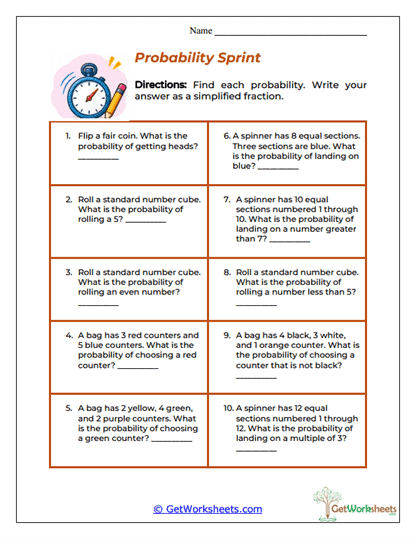
Probability Sprint
Developing fluency with basic probability calculations requires students to recognize possible outcomes and represent the likelihood of an event as a fraction. This focused statistics activity for Grades 4-6 presents ten probability problems involving fair coins, standard number cubes, colored counters, and equally divided spinners. Learners determine the number of favorable outcomes, identify the total number of equally likely possibilities, and express each probability as a simplified fraction. Through these exercises, students strengthen fraction operations, probability calculations, number sense, outcome counting, divisibility recognition, and mathematical reasoning while applying theoretical probability to familiar random experiments.
Instructional Objectives
-
Calculating Theoretical Probability: Determine the probability of an event by dividing the number of favorable outcomes by the total number of equally likely outcomes.
-
Identifying Favorable Outcomes: Analyze conditions involving specific numbers, even values, numbers within a range, and selected colors.
-
Simplifying Probability Fractions: Reduce fractional answers to their simplest equivalent forms using common factors.
-
Applying Numerical Reasoning: Recognize mathematical properties such as multiples, parity, and numerical comparisons when counting possible outcomes.
Instructional Benefits
-
Ten Targeted Exercises: Provides meaningful repetition with different probability situations and numerical conditions.
-
Cross-Curricular Math Connections: Reinforces fraction simplification, factors, multiples, and number properties within statistical applications.
-
Varied Random Experiments: Includes coins, dice, spinners, and colored counters to develop familiarity with common probability models.
-
Independent Skill Practice: Short problems encourage students to apply the same mathematical procedure in different contexts.
-
Print-and-Go Convenience: Suitable for classroom assignments, guided practice, math centers, homework, and homeschool instruction.
Calculating probabilities as simplified fractions helps students understand how numerical relationships describe the likelihood of random events. By identifying favorable outcomes, counting equally likely possibilities, constructing probability fractions, and reducing answers, learners strengthen mathematical accuracy and computational fluency. Teachers can extend the activity by asking students to explain why a probability fraction cannot exceed one or compare which events are more likely to occur. This printable reinforces proportional reasoning, fraction comprehension, statistical vocabulary, and problem-solving confidence while preparing learners for compound probability, probability distributions, and more advanced statistical investigations.
Bookmark Us Now!
New, high-quality worksheets are added every week! Do not miss out!