Target Average
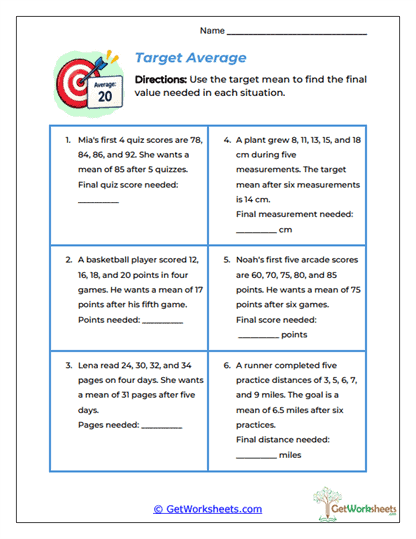
Working backward from a desired average helps students develop a deeper understanding of the relationship between arithmetic means, numerical totals, and unknown values. Designed for Grades 5-7, this practical statistics activity presents six real-world situations involving quiz scores, basketball points, reading progress, plant growth, arcade games, and running distances. Each problem provides a target mean and a collection of known observations, challenging learners to calculate the final value needed to achieve the specified average. The exercises reinforce inverse operations, multiplication, subtraction, algebraic thinking, numerical reasoning, statistical problem-solving, and the application of averages to measurable goals.
Targeted Skills
-
Understanding Target Means: Recognize how a desired arithmetic average determines the total sum needed across a specific number of observations.
-
Applying Inverse Operations: Multiply the target mean by the total number of values, then subtract the known observations to find the missing quantity.
-
Solving Real-World Problems: Interpret numerical information from academic, athletic, scientific, and recreational situations.
-
Verifying Mathematical Results: Substitute the calculated missing value into the completed data set and confirm that the resulting mean matches the target.
Classroom & Home Use
-
Six Goal-Oriented Challenges: Provides meaningful situations where students must determine a required final score, measurement, or quantity.
-
Algebraic Reasoning Development: Introduces the process of solving for an unknown through relationships between totals, averages, and observations.
-
Multistep Mathematical Practice: Requires careful reading, addition, multiplication, and subtraction to arrive at accurate solutions.
-
Real-Life Connections: Demonstrates how averages can help establish academic goals, monitor progress, and interpret performance targets.
-
Flexible Instructional Application: Appropriate for guided lessons, enrichment activities, independent assignments, and homeschool mathematics practice.
Solving target-average problems helps students understand how arithmetic means can be used to make mathematical predictions and determine missing information. Through reverse calculations, total-sum reasoning, numerical comparisons, and solution verification, learners strengthen computational accuracy and mathematical flexibility. Teachers can extend the activity by asking students to explain whether their calculated final values are realistic or to create new scenarios involving different target averages. This printable develops statistical comprehension, logical reasoning, problem-solving confidence, and introductory algebra skills while preparing students for equations involving unknown quantities and more advanced applications of measures of central tendency.
Bookmark Us Now!
New, high-quality worksheets are added every week! Do not miss out!