Hidden Number
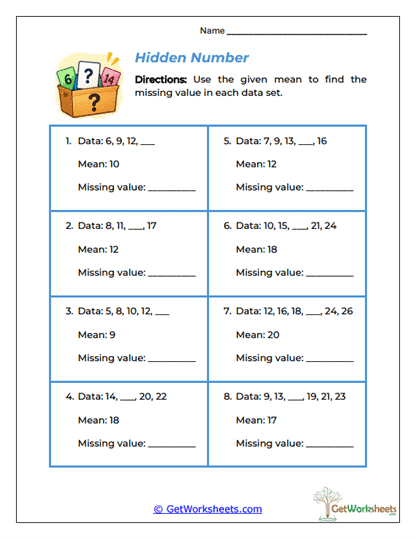
Solving for an unknown value in a numerical data set challenges students to apply their understanding of averages in reverse. This engaging statistics activity for Grades 5-7 presents eight partially completed data sets, each containing one missing number and a specified arithmetic mean. Students must determine the total required to produce the given average, calculate the sum of the known values, and use subtraction to identify the missing observation. These exercises reinforce inverse operations, multiplication, addition, subtraction, algebraic reasoning, numerical relationships, and the mathematical principles underlying the calculation of the mean.
Targeted Skills
-
Working Backward from the Mean: Multiply the given average by the number of observations to determine the required total.
-
Calculating Known Quantities: Add the provided values to establish how much of the total is already accounted for.
-
Finding Missing Values: Apply subtraction to determine the unknown number needed to produce the specified mean.
-
Verifying Solutions: Substitute the calculated value into the original data set and recompute the average to confirm accuracy.
Instructional Benefits
-
Eight Reverse-Calculation Problems: Encourages students to think beyond routine average calculations and apply a more advanced problem-solving strategy.
-
Introduction to Algebraic Thinking: Missing-value exercises provide a natural connection between statistics, unknown quantities, and inverse operations.
-
Progressive Mathematical Reasoning: Problems involving different data set sizes require careful attention to the number of observations.
-
Self-Checking Opportunities: Students can verify each answer by recalculating the mean after replacing the missing value.
-
Flexible Instruction: Suitable for guided practice, enrichment activities, independent assignments, formative assessment, and homeschool instruction.
Finding missing values helps students understand that the arithmetic mean describes a relationship between the total sum and the number of observations. Through reverse calculations, numerical reasoning, multiplication, subtraction, and solution verification, learners develop a deeper understanding of statistical relationships. Teachers can model the process using the equation Mean × Number of Values = Total before encouraging students to solve each problem independently. This printable strengthens mathematical flexibility, problem-solving confidence, and computational accuracy while preparing students for introductory algebra, equations involving unknown values, and more advanced statistical applications.
Bookmark Us Now!
New, high-quality worksheets are added every week! Do not miss out!