Arcade Scoreboard
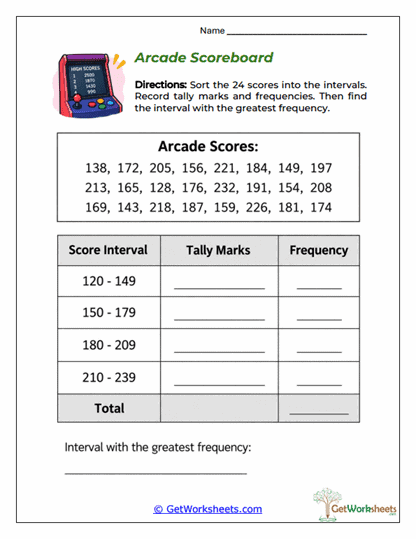
This Arcade Scoreboard Worksheet helps students in Grades 4-6 practice organizing numerical data into grouped frequency tables using an engaging arcade game theme. Students examine 24 arcade scores and classify each value into one of four designated intervals: 120-149, 150-179, 180-209, and 210-239. After recording tally marks and numerical frequencies, learners calculate the total number of scores and identify the interval containing the greatest frequency. The activity reinforces grouped frequency distributions, numerical sorting, tally counting, interval classification, frequency comparison, and statistical interpretation through a familiar recreational context.
Academic Focus
-
Sorting Scores into Intervals: Determine the correct numerical range for each recorded arcade score.
-
Constructing Grouped Frequencies: Represent the number of scores in each class interval using tally marks and numerical counts.
-
Calculating Total Frequency: Add the grouped frequencies to verify that all 24 scores have been classified.
-
Identifying the Modal Class: Compare interval frequencies to determine which score range contains the most observations.
Teaching Advantages
-
Engaging Real-World Theme: Arcade scores make numerical data classification approachable and relevant to students.
-
Targeted Statistics Practice: Reinforces essential grouped frequency table skills without requiring students to design the intervals.
-
Clear Organizational Structure: A prepared three-column table supports sorting, tally recording, and frequency calculations.
-
Versatile Instruction: Appropriate for classroom assignments, math centers, homework, independent assessments, and homeschool practice.
This printable statistics worksheet helps learners understand how large numerical data sets can be summarized using class intervals. Students strengthen their ability to organize arcade scores, record tally marks, calculate grouped frequencies, verify totals, and identify the most common score range. The activity promotes mathematical accuracy, logical classification, numerical fluency, and confidence in interpreting statistical distributions. Teachers and homeschool families can use it to prepare students for more advanced work with grouped data, histograms, frequency comparisons, modal classes, and statistical reasoning.
Bookmark Us Now!
New, high-quality worksheets are added every week! Do not miss out!