Fare Check
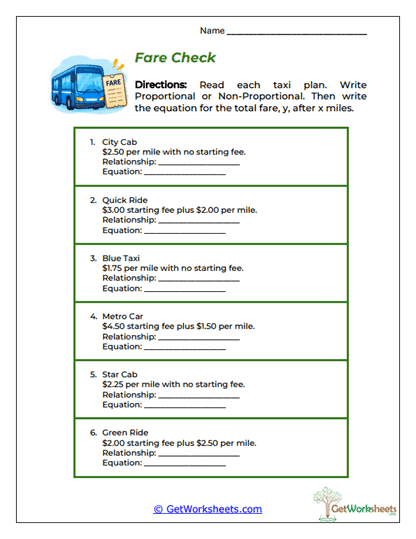
This worksheet uses taxi fare plans to help students decide whether a relationship is proportional or non-proportional, then asks them to write an equation for the total fare after x miles. Some plans charge only a per-mile rate, while others include a starting fee plus a per-mile charge. That makes the worksheet especially useful because students have to connect a real-world situation to both the classification and the algebraic equation.
For a parent, the key idea is simple: if the taxi charges only by the mile and there is no starting fee, then the relationship is proportional. If there is a starting fee before the car travels any distance, then the relationship is non-proportional. The equation shows that difference clearly. A proportional fare might look like y = 2.50x, while a non-proportional fare might look like y = 2x + 3.
Learning Goals
- Classify Fare Plans: Students decide whether each taxi plan is proportional or non-proportional.
- Identify Starting Fees: Learners notice whether the total begins above zero.
- Write Linear Equations: Students represent each situation with an equation for total fare.
- Connect Rate and Starting Value: Learners distinguish the per-mile rate from the initial charge.
- Apply Proportional Reasoning to Real Life: Students see how transportation pricing can be modeled mathematically.
Parent-Friendly Teaching Tips
Ask:
“If the taxi travels 0 miles, would the fare also be $0?”
If yes, the relationship is proportional.
If the plan says there is a $3 starting fee, then at 0 miles the passenger already owes $3, so the relationship is non-proportional.
For example:
$2.50 per mile, no starting fee
Equation:
y = 2.5x
Proportional.
But:
$3 starting fee plus $2 per mile
Equation:
y = 2x + 3
Non-Proportional.
Why This Worksheet Helps
- Makes Equations Meaningful: Students see what the coefficient and constant represent.
- Connects Real-World Language to Algebra: Learners turn pricing descriptions into equations.
- Builds y = kx vs. y = mx + b Understanding: Students begin recognizing the role of the starting value.
- Encourages Interpretation: The math represents actual parts of the fare structure.
- Prepares for Linear Functions: This is an excellent bridge into slope and y-intercept concepts.
The real value of this worksheet is that students learn to recognize proportionality from both the story and the equation. Rates, starting fees, variables, and linear relationships all work together. For parents, the best reminder is: “No starting fee means it can be proportional; a starting fee means it is not.”
Bookmark Us Now!
New, high-quality worksheets are added every week! Do not miss out!