Zero Start
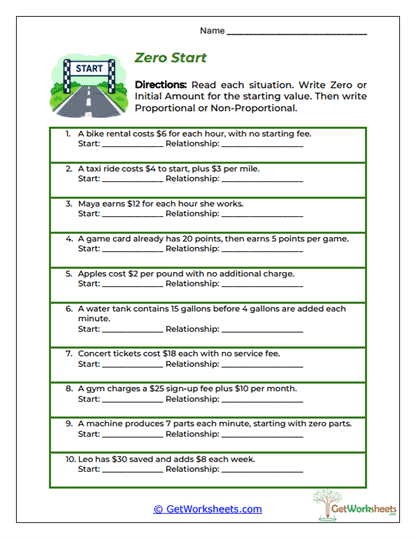
This worksheet gives students real-world situations and asks them to identify whether each one starts at zero or with an initial amount, then classify the relationship as proportional or non-proportional. Situations include hourly rates, taxi fares, wages, game scores, grocery prices, tank amounts, ticket charges, sign-up fees, machine production, and savings. The key idea is that a proportional relationship starts with zero when the input is zero. If there is already some amount before the regular rate begins, the relationship is non-proportional.
For a parent, this is one of the most useful real-life ways to explain the topic. If a bike rental costs $6 per hour with no starting fee, then at 0 hours the cost is $0. That is proportional. But if a taxi costs $4 to start plus $3 per mile, then at 0 miles the cost is already $4. That makes the relationship non-proportional.
Key Learning Objectives
- Identify Starting Values: Students determine whether a situation begins at 0 or at some initial amount.
- Classify Real-World Relationships: Learners label each situation proportional or non-proportional.
- Connect Starting Amounts to Graphs and Equations: Students see how an initial amount becomes a nonzero y-intercept.
- Understand Constant Rates: Learners recognize that a constant rate alone is not enough if there is also a starting fee.
- Build Real-World Algebra Sense: Students connect everyday situations to linear equations.
Parent-Friendly Explanation
Ask two questions:
- What would happen if the input were zero?
- Would the output also be zero?
If yes, the relationship can be proportional.
For example:
$2 per pound with no extra charge
At 0 pounds, the cost is $0.
Proportional.
But:
$25 sign-up fee plus $10 per month
At 0 months, the cost is already $25.
Non-Proportional.
Why This Worksheet Helps
- Makes the Topic Practical: Starting fees and initial amounts are easy to understand in real life.
- Connects to y-intercepts: Students begin understanding what the constant term in an equation means.
- Builds Decision-Making Skills: Learners classify without needing to calculate a full table.
- Supports Word-Problem Reasoning: Students pull out the important information from each situation.
- Prepares for Linear Models: The distinction between “rate only” and “rate plus start” is foundational.
The real value of this worksheet is that it teaches students to recognize proportionality through the idea of a zero starting point. Rates, starting fees, initial values, and real-world situations all connect. For parents, the best question is: “If we did zero of the activity, would the total also be zero?”
Bookmark Us Now!
New, high-quality worksheets are added every week! Do not miss out!