Origin Check
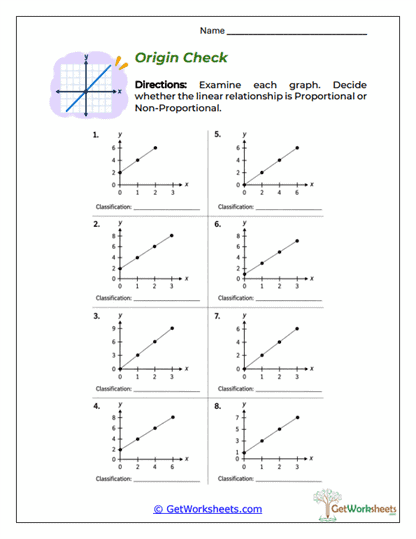
This worksheet helps students decide whether a graphed linear relationship is Proportional or Non-Proportional by checking whether the line passes through the origin, (0,0). Each graph shows a straight-line pattern, but some begin at zero while others start above or below it. That difference is the key. A proportional relationship must pass through the origin because when x = 0, y must also equal 0. This activity strengthens graph reading, coordinate-plane understanding, proportional reasoning, and the connection between visual patterns and equations.
For a parent, the easiest rule is: if the line goes through (0,0), it can be proportional; if it misses the origin, it is not proportional. The origin is where the x-axis and y-axis cross. It is the graphing version of saying there is no starting amount.
Learning Goals
- Recognize the Origin: Students identify the point (0,0) on a graph.
- Classify Graphs: Learners decide whether each line represents a proportional or non-proportional relationship.
- Connect Graphs to y = kx: Students understand that proportional graphs come from equations with no added starting value.
- Build Visual Reasoning: Learners use the graph itself as evidence.
- Prepare for Slope and Linear Functions: Students begin distinguishing lines through the origin from other linear relationships.
Parent-Friendly Teaching Tips
Use this routine:
- Find the point where the axes cross.
- Ask whether the line goes through that point.
- If yes, classify it as Proportional.
- If no, classify it as Non-Proportional.
For example, a line that includes:
(0,0), (1,2), (2,4), (3,6)
is proportional.
But a line that includes:
(0,2), (1,4), (2,6), (3,8)
is not proportional because it starts at 2 instead of 0.
Why This Worksheet Helps
- Makes Proportionality Visual: Students can see the difference instead of only calculating ratios.
- Connects Tables, Equations, and Graphs: The origin corresponds to the “no extra starting value” idea.
- Builds Coordinate-Plane Fluency: Learners practice reading x- and y-values.
- Prepares for Slope-Intercept Form: Students begin noticing the role of a y-intercept.
- Encourages Multiple Representations: Students see that proportionality can be identified in more than one way.
The main value of this worksheet is that it teaches students to recognize proportionality from a graphical clue. The origin, straight lines, coordinates, and proportional relationships all work together. For parents, the best reminder is: “A proportional line has to pass through zero.”
Bookmark Us Now!
New, high-quality worksheets are added every week! Do not miss out!