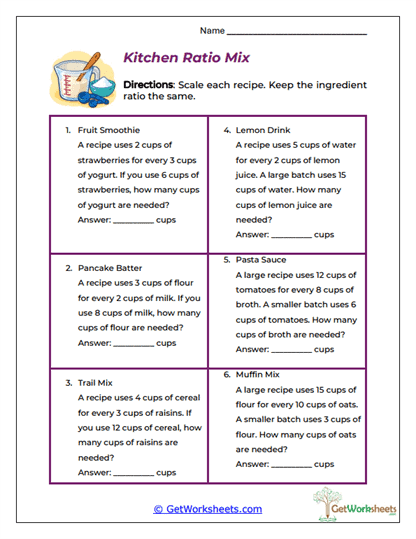
Kitchen Ratio Mix
This worksheet gives students a very practical way to understand equivalent ratios by using recipes and ingredient amounts. Each problem describes a recipe with two ingredients, such as fruit and yogurt, flour and milk, cereal and raisins, water and lemon juice, tomatoes and broth, or flour and oats. Students then have to scale the recipe up or down while keeping the ingredient relationship the same. That makes the activity especially useful because students are not just looking at two numbers and asking whether they match-they are using ratios to make sure a recipe would still taste right after changing the size of the batch.
For a parent, the easiest way to explain this is to think about doubling or tripling a recipe. If a smoothie uses 2 cups of strawberries for every 3 cups of yogurt, then making twice as much means using 4 cups of strawberries and 6 cups of yogurt. You cannot double one ingredient and leave the other unchanged, because that would change the recipe. Equivalent ratios are really about keeping the same balance.
Learning Goals
- Scale Ratios Up or Down: Students change ingredient amounts while keeping the relationship the same.
- Use Multiplication and Division: Learners find the scale factor needed to move from one batch size to another.
- Apply Ratios to Real Life: Students see how proportions are used in cooking and recipes.
- Keep Quantities in the Same Relationship: Learners understand that both parts must change together.
- Build Proportional Reasoning: Students connect ratios with practical situations where balance matters.
Parent-Friendly Teaching Tips
A good question to ask is:
“How much bigger or smaller is the new batch?”
For example, if the original recipe uses:
2 cups strawberries
3 cups yogurt
and the new recipe uses:
6 cups strawberries
then 2 became 6 by multiplying by 3.
So:
3 × 3 = 9 cups yogurt.
The answer is 9 cups.
Why This Worksheet Helps
- Makes Ratios Meaningful: Students can picture why ingredient amounts have to stay balanced.
- Builds Multiplicative Thinking: Learners focus on scaling instead of adding random amounts.
- Connects Math to Everyday Life: Recipes are a natural example of equivalent ratios.
- Strengthens Mental Math: Many problems can be solved by recognizing simple multiplication factors.
- Prepares for Proportions: Recipe scaling is one of the clearest real-world examples of proportional relationships.
The real value of this worksheet is that it helps students understand equivalent ratios as keeping the same mixture while changing the amount. Ingredients, scale factors, multiplication, division, and proportional reasoning all work together. For parents, the best reminder is: “If the batch changes, both ingredients have to change by the same factor.” In classroom and homeschool settings, this worksheet gives students a strong real-world reason for why equivalent ratios matter.
Bookmark Us Now!
New, high-quality worksheets are added every week! Do not miss out!