Ratio Table Quest
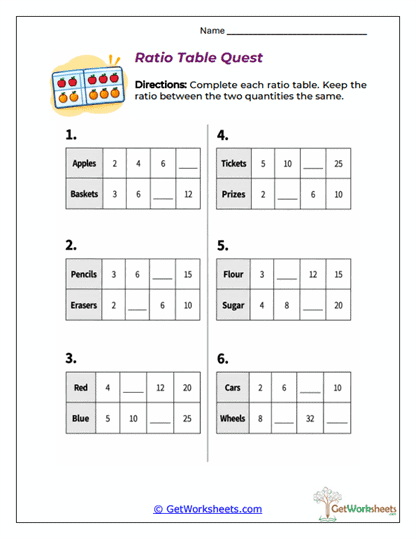
This worksheet asks students to complete ratio tables by filling in missing values while keeping the relationship between the two rows the same. Each table uses a practical pair of quantities, such as apples and baskets, pencils and erasers, red and blue items, tickets and prizes, flour and sugar, or cars and wheels. Students must look across each row, figure out the scale pattern, and fill in the missing values so that every column shows an equivalent ratio.
For a parent, ratio tables can be thought of as repeated versions of the same recipe. If 2 apples go with 3 baskets in one column, then 4 apples would go with 6 baskets in another if both quantities are doubled. The relationship has to stay consistent from column to column. Students are learning that the numbers may change, but the rate between them stays the same.
Key Learning Objectives
- Complete Equivalent Ratio Tables: Students fill missing values in paired rows.
- Use Consistent Scale Factors: Learners multiply or divide both quantities by the same amount.
- Recognize Patterns Across Columns: Students notice how the values grow or shrink.
- Connect Ratios to Real Quantities: Learners work with objects and measurements instead of isolated numbers.
- Build Proportional Reasoning: Students understand that every column represents the same ratio relationship.
Parent-Friendly Explanation
Start with one complete column.
For example:
Apples: 2
Baskets: 3
If another column shows 4 apples, ask:
“What happened to 2?”
It doubled.
So 3 must also double:
3 × 2 = 6 baskets.
That keeps the ratio equivalent.
Why This Worksheet Helps
- Makes Ratios Easier to Visualize: Tables organize the relationship clearly.
- Builds Pattern Recognition: Students see repeated scaling across several columns.
- Prepares for Unit Rates and Proportions: Ratio tables are used throughout middle-school math.
- Supports Word Problems: Many real situations can be organized into a ratio table.
- Strengthens Multiplication and Division: Students use both operations to complete missing values.
Classroom & Home Use
- Great for Guided Practice: Teachers or parents can complete the first missing value together.
- Helpful for Visual Learners: The rows and columns make the relationship easier to follow.
- Useful for Intervention: Students who struggle with abstract ratios often do better with tables.
- Good for Homeschooling: Families can create similar tables using everyday examples like snacks, toys, or recipes.
- Strong for Review: The worksheet reinforces equivalent ratios without relying only on fraction notation.
The real value of this worksheet is that it shows students equivalent ratios as a pattern that repeats across a table. Multiplication, division, paired quantities, scale factors, and proportional reasoning all work together. For parents, the best question is: “How did the top number change, and did the bottom number change the same way?” In classroom and homeschool settings, this activity builds the kind of proportional thinking students need for rates, proportions, and real-world math.
Bookmark Us Now!
New, high-quality worksheets are added every week! Do not miss out!