Error Search
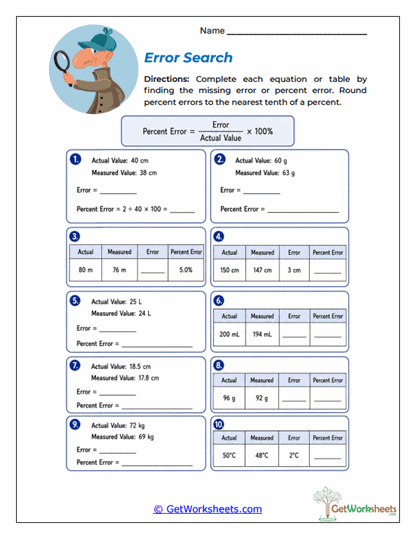
This worksheet mixes equations and small data tables so students must fill in whichever part of the percent error process is missing. Some problems ask students to find the numerical error first and then calculate percent error, while others provide one piece of the work and ask students to complete the remaining values. That varied format strengthens actual-versus-measured reasoning, absolute difference, division, percent conversion, table reading, and flexible problem solving while keeping students from relying on one repeated layout. It is especially useful for grades 6-8 students who understand the percent error formula and are ready to apply it across different representations.
Key Learning Objectives
- Find Missing Numerical Error: Students calculate the absolute difference between measured and actual values.
- Complete Percent Error Equations: Learners divide the error by the actual value and multiply by 100.
- Read Multiple Formats: Students switch between standard equations and compact data tables.
- Round Percent Error Correctly: Learners report answers to the nearest tenth of a percent when required.
Educational Value
- Builds Flexibility: Students see that the same percent error relationship can appear in several different formats.
- Parent-Friendly Routine: Adults can ask, “What piece is missing-error or percent error-and what information do we already have?”
- Makes the Process Visible: The worksheet separates actual value, measured value, error, and percent error so students can see how they connect.
- Great for Review: The variety makes it useful for test preparation, homework, intervention, or independent practice.
- Supports Science Skills: The table format resembles how experimental measurements are often recorded.
This worksheet helps students understand the structure behind percent error rather than memorizing one worksheet pattern. Actual values, measured values, numerical error, division, percentages, tables, and rounding all work together as students complete each missing piece. For parents, the process can be explained as a chain: first find how far the measurement missed, then compare that miss with the actual value, then turn the result into a percent. In classroom and homeschool settings, this activity builds flexible problem-solving skills and prepares students for percent error in science, measurement, and data-analysis settings.
Bookmark Us Now!
New, high-quality worksheets are added every week! Do not miss out!