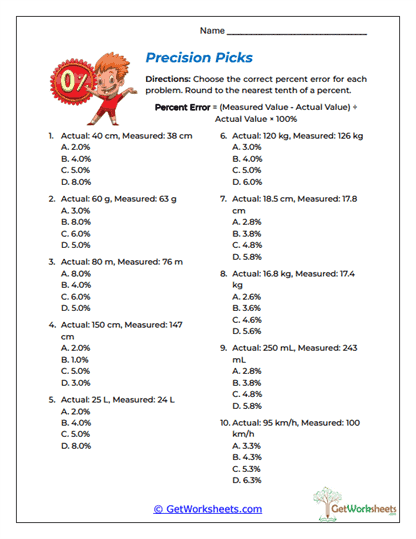
Precision Picks
This worksheet gives students a multiple-choice challenge where they must calculate percent error and choose the best answer from several possibilities. Students work with actual and measured values involving centimeters, grams, meters, liters, kilograms, milliliters, and speed, then apply the percent error formula and round to the nearest tenth of a percent when necessary. The answer choices often differ by only a small amount, so students must be careful with subtraction, division, decimal-to-percent conversion, and rounding. The activity strengthens percent error, measurement, estimation, comparison, and number sense while giving students practice recognizing whether an answer is reasonable. It is especially useful for grades 6-8 students who know the formula and need faster, more independent practice.
Key Learning Objectives
- Find the Absolute Error: Students determine the positive difference between actual and measured values.
- Apply the Percent Error Formula: Learners divide that difference by the actual value and multiply by 100.
- Round Carefully: Students report answers to the nearest tenth of a percent when needed.
- Evaluate Answer Choices: Learners compare several possible results and choose the one that matches their calculation.
Educational Value
- Good for Test Preparation: Students practice working through a formula while also evaluating close answer choices.
- Parent-Friendly Routine: Ask, “How far off was the measurement, and what percent of the actual amount is that?”
- Encourages Estimation: Students can often tell whether the answer should be around 2%, 5%, or another range before calculating exactly.
- Targets Common Errors: Distractor choices can reveal mistakes involving the wrong denominator, skipped multiplication by 100, or poor rounding.
- Flexible for Practice: The worksheet works well for homework, centers, review, intervention, or homeschool instruction.
This worksheet helps students combine calculation with judgment. Actual values, measured values, errors, percentages, rounding, and answer comparison all work together as students choose each result. For parents, it can help to estimate first: if a measurement is only slightly different from the actual value, the percent error should probably be fairly small. That quick sense-check gives students another way to catch mistakes. In classroom and homeschool settings, this activity builds percent-error fluency and helps students become more confident with measurement-based multiple-choice problems.
Bookmark Us Now!
New, high-quality worksheets are added every week! Do not miss out!