Percentage Errors
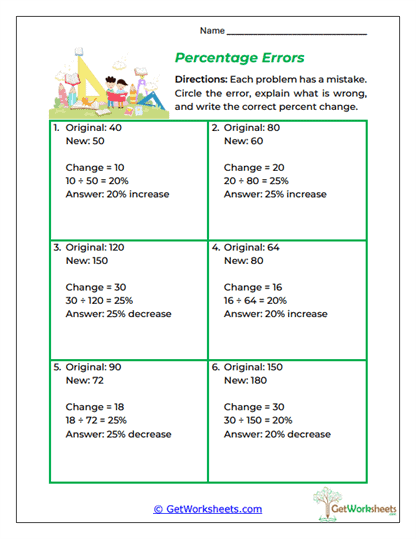
This worksheet turns percent change into an error-analysis challenge by showing students completed problems that contain a mistake and asking them to figure out exactly what went wrong. Students inspect examples involving changes such as 40 to 50, 80 to 60, 120 to 150, and 64 to 80, then circle the error, explain the problem, and write the correct percent change. The activity strengthens subtraction, percent increase, percent decrease, division, original-value reasoning, error analysis, and mathematical explanation while targeting one of the most common mistakes in percent change: dividing by the wrong number. It is especially useful for grades 6-7 students who know the percent-change formula but need practice understanding why the original value must be used as the reference point.
Learning Goals
- Check the Amount of Change: Students verify that the difference between the original and new values was calculated correctly.
- Inspect the Denominator: Learners decide whether the change was divided by the original value rather than the new value.
- Label Increase or Decrease Correctly: Students make sure the direction of change matches the numbers.
- Explain the Mistake: Learners describe what went wrong instead of simply replacing the final answer.
Classroom & Home Use
- Turns Wrong Work Into a Lesson: Students learn more from diagnosing a mistake than from simply being told an answer is incorrect.
- Parent-Friendly Question: Ask, “What number did the problem start with, and did they divide the change by that starting value?”
- Builds Self-Checking Habits: Students become more likely to inspect their own percent-change work for the same errors.
- Useful for Intervention: Teachers can quickly see whether confusion comes from subtraction, the denominator, or labeling the direction.
- Great for Deeper Review: The worksheet works well for small groups, homework, assessment, or homeschool lessons.
This worksheet helps students understand that percent change is not just “find a difference and divide.” The original value matters because the percentage tells us how large the change is compared with where the quantity started. Original value, new value, amount of change, division, increase, decrease, and mathematical reasoning all work together as students repair each problem. For parents, a change from 40 to 50 is a useful example: the increase is 10, but 10 must be compared with the original 40, not the new 50. That makes the correct percent increase 25%. In classroom and homeschool settings, this activity builds accuracy and helps students avoid the mistakes that most often cause trouble with percent change.
Bookmark Us Now!
New, high-quality worksheets are added every week! Do not miss out!