Missing Whole
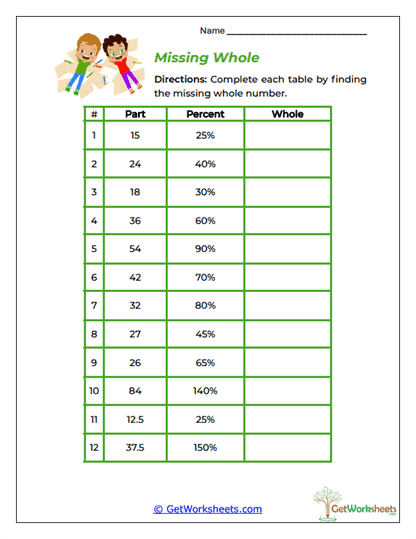
This worksheet organizes missing-whole percent problems into a clear table with three columns: Part, Percent, and Whole. Students are given values such as 15 at 25%, 24 at 40%, 36 at 60%, 54 at 90%, and 84 at 140%, then calculate the missing total for each row. The structured format strengthens percent-to-decimal conversion, division, equations, proportional reasoning, number sense, and table reading while giving students repeated practice with the same important relationship. It is especially useful for grades 5-6 students who benefit from seeing exactly which values are known and which one must be found.
Key Learning Objectives
- Read Part and Percent from a Table: Students identify the two known values in each row before solving.
- Convert Percent to Decimal Form: Learners rewrite each percentage so it can be used in the division equation.
- Use Whole = Part ÷ Percent: Students apply the same relationship consistently across a variety of values.
- Handle Percents Above 100%: Values such as 140% and 150% help students understand that the missing whole may be smaller than the given part.
Educational Value
- Great for Students Who Need Structure: The table keeps the part, percent, and whole visually separated.
- Parent-Friendly Routine: Adults can say, “We know the part and we know what percent it represents, so divide the part by that percent written as a decimal.”
- Builds Fluency Through Repetition: The consistent format helps students become faster and more confident with the process.
- Makes Patterns Easier to Notice: Students can compare rows and see how changing the percentage affects the whole.
- Flexible for Practice: The worksheet works well for homework, centers, intervention, independent work, or homeschool instruction.
This worksheet helps students build a dependable routine for missing-whole percent problems. Part, percent, whole, decimals, division, proportions, and number sense all work together as students complete each row. For parents, a row such as Part = 24 and Percent = 40% can be explained as 24 ÷ 0.40 = 60, so 24 must be 40% of 60. The table format makes it easy to check whether students are using the correct numbers in the correct roles. In classroom and homeschool settings, this activity strengthens both procedural fluency and a clearer understanding of how parts and totals are connected through percentages.
Bookmark Us Now!
New, high-quality worksheets are added every week! Do not miss out!