Percentage Situations
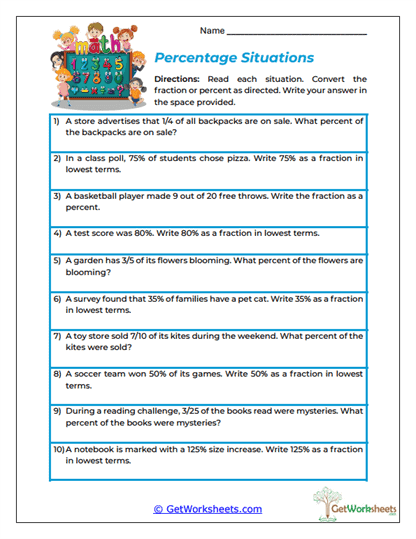
This worksheet places fraction-percent conversion inside short real-world situations so students have to understand what the numbers mean before converting them. Students read scenarios involving store sales, pizza choices, free throws, test scores, blooming flowers, pet surveys, toy sales, soccer wins, reading challenges, and size increases, then write the equivalent fraction or percent as directed. The activity combines fractions, percentages, word-problem comprehension, equivalent values, simplification, number sense, and real-world reasoning in a way that feels more purposeful than isolated conversion drills. It is especially useful for grades 5-6 students who know how to convert between fractions and percents but need practice recognizing when and why those conversions are useful.
Key Learning Objectives
- Translate Real Situations Into Math: Students identify the fraction or percent hidden inside each everyday context.
- Convert Fractions to Percents: Learners express quantities such as part of a group or number of successes as percentages.
- Convert Percents to Fractions: Students rewrite given percentages as fractions and simplify them to lowest terms.
- Interpret Values Above 100%: Situations involving 125% help students understand that a percent can describe more than one whole.
Educational Value
- Makes Percent Math Feel Real: Sales, scores, sports, surveys, and growth are situations students may actually encounter.
- Parent-Friendly Discussion: Adults can ask, “What part of the whole is being described, and how else could we write that same amount?”
- Strengthens Reading and Math Together: Students have to understand the story before choosing the correct conversion.
- Builds Practical Number Sense: The worksheet helps students see why fraction-percent equivalence matters beyond the classroom.
- Flexible for Many Settings: It works well for homework, centers, review, intervention, enrichment, or homeschool instruction.
This worksheet is valuable because students are not just converting symbols-they are interpreting quantities that have meaning. Fractions, percents, equivalent values, simplification, rates, part-whole relationships, and word-problem reasoning all work together as students solve each situation. For parents, the big idea is that “3/5 of the flowers” and “60% of the flowers” tell the same story in different forms. Once children see that connection in sports, shopping, school, and everyday data, percentages become much less abstract. In classroom and homeschool settings, this activity helps students apply conversion skills in the kinds of situations where percentages are actually used.
Bookmark Us Now!
New, high-quality worksheets are added every week! Do not miss out!