Number Possibilities
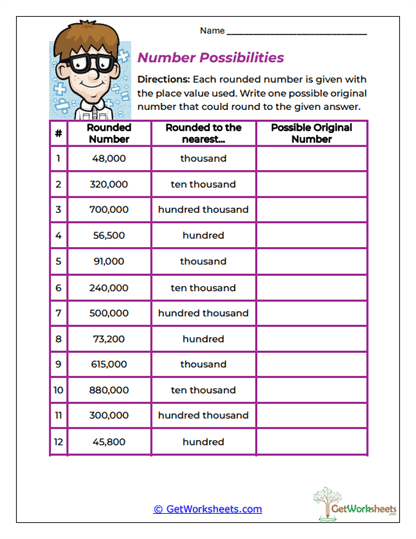
This worksheet flips the usual rounding process around by giving students the rounded answer first and asking them to invent an original number that could have produced it. Students work backward from values such as 48,000, 320,000, 56,500, and 615,000 while paying attention to whether the original number was rounded to the nearest hundred, thousand, ten-thousand, or hundred-thousand. That reverse-thinking format strengthens rounding ranges, place value, benchmark numbers, estimation, inequalities, number magnitude, and flexible reasoning because students must understand which original values belong inside each rounding interval. It is especially useful for grades 4-5 students who have mastered basic rounding and are ready for a more open-ended challenge with multiple possible answers.
Key Learning Objectives
- Work Backward From an Estimate: Students start with the rounded number and determine one possible original value.
- Understand Rounding Intervals: Learners recognize that many different numbers can round to the same hundred, thousand, or larger benchmark.
- Think About Upper and Lower Boundaries: Students consider how far an original number can move before it would round to a different result.
- Develop Flexible Number Sense: Because several answers may be correct, students learn to justify a reasonable possibility rather than search for one memorized answer.
Educational Value
- Feels Like a Number Puzzle: Students have to build a number that fits the rounding clue instead of simply applying a familiar procedure.
- Parent-Friendly Conversation: Ask, “What numbers could live close enough to this benchmark to round here?”
- Excellent for Deeper Understanding: The activity reveals whether students truly understand rounding ranges rather than only the forward algorithm.
- Naturally Encourages Multiple Answers: Students can compare different possible original numbers and check whether each one works.
- Useful for Enrichment: The worksheet is a strong choice for centers, challenge work, assessment, homework, or homeschool practice.
The strength of this worksheet is that it makes students think about everything hidden behind a rounded number. Place value, rounding ranges, benchmark numbers, estimation, boundaries, magnitude, reverse reasoning, and number sense all work together as students create possible original values. For parents, a rounded value such as 73,200 is no longer just an answer-it represents a whole group of nearby numbers that could have produced it. Students begin to understand that rounding describes a range rather than one exact starting value. In classroom and homeschool settings, this activity develops flexible mathematical thinking and prepares students for later work involving inequalities, intervals, error bounds, and more advanced estimation.
Bookmark Us Now!
New, high-quality worksheets are added every week! Do not miss out!