Measure and Round
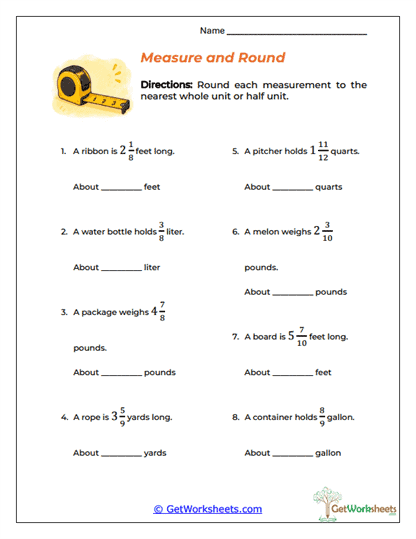
This worksheet connects fraction rounding with real-world measurement by asking students to estimate lengths, weights, and capacities to the nearest whole unit or half unit. Students work with examples involving ribbon, water, packages, rope, pitchers, melons, boards, and containers, using measurements such as feet, liters, pounds, yards, quarts, and gallons. That practical mix strengthens fraction estimation, mixed numbers, measurement, benchmark fractions, unit sense, magnitude, and real-world reasoning while helping students understand that fractions describe actual quantities, not just symbols on a page. It is especially useful for grades 4-5 students who are learning to estimate measurements and need practice deciding whether a fractional amount is closer to a whole number or a half.
Key Learning Objectives
- Round Measurement Fractions: Students estimate fractional and mixed-number measurements to nearby whole or half units.
- Connect Fractions to Real Quantities: Learners see how fractions appear naturally in length, weight, and capacity situations.
- Use Benchmarks in Context: Students decide whether a measurement is closer to the lower whole, halfway point, or next whole.
- Strengthen Unit Awareness: Feet, liters, pounds, yards, quarts, and gallons reinforce the idea that estimation applies across many measurement types.
Instructional Benefits
- Makes Fractions Easier to Picture: A ribbon that is a little over 2 feet long gives students a concrete way to think about mixed numbers.
- Parent-Friendly Discussion: Adults can ask, “Is this amount closer to the whole number, the half, or the next whole?”
- Links Math to Everyday Measurement: Students see why a rough measurement can still be useful when exact precision is not needed.
- Supports Measurement Review: The worksheet revisits several common units while reinforcing fraction sense.
- Works in Many Settings: It is useful for homework, centers, review, intervention, or homeschool instruction.
This worksheet is valuable because it helps students connect benchmark fractions with objects and measurements they can imagine. Fractions, mixed numbers, halves, whole units, length, weight, capacity, estimation, and number sense all work together as students decide about how much each measurement represents. For parents, a statement such as “a melon weighs 2 3/10 pounds” becomes easier to discuss when the child can say it is about 2 1/2 pounds. That kind of estimation helps students see fractions as quantities with size and meaning. In classroom and homeschool settings, this activity builds stronger fraction intuition while also reinforcing practical measurement skills.
Bookmark Us Now!
New, high-quality worksheets are added every week! Do not miss out!