Kitchen Estimates
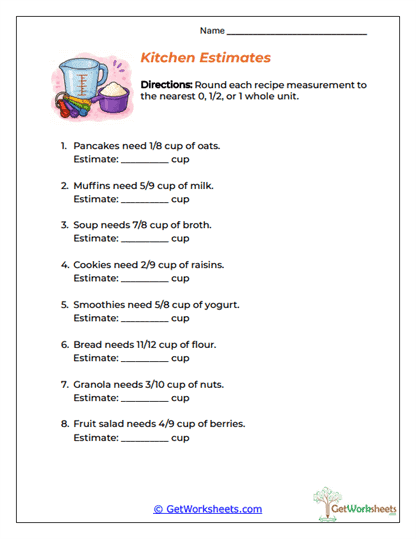
This worksheet brings fraction rounding into the kitchen by asking students to estimate common recipe measurements using 0, 1/2, or 1 whole unit. Students work with cup amounts such as 1/8 cup of oats, 5/9 cup of milk, 7/8 cup of broth, and 4/9 cup of berries, then choose the benchmark measurement that is closest. The recipe theme gives students practice with fractions, benchmark values, capacity, measurement, estimation, numerator-denominator relationships, and number sense in a setting that feels practical and familiar. It is especially useful for grades 4-5 students who are learning to connect fraction size with real quantities instead of viewing fractions only as numbers on a worksheet.
Targeted Skills
- Estimate Recipe Amounts: Students round fractional cup measurements to 0, 1/2, or 1 cup.
- Connect Fractions to Capacity: Learners see that a fraction describes a real amount that could be poured or measured.
- Use Benchmarks Efficiently: Students decide whether each ingredient amount is tiny, about half a cup, or almost a full cup.
- Strengthen Practical Number Sense: The activity connects fraction magnitude with an everyday measurement situation.
Classroom & Home Use
- Easy to Picture: Measuring cups and recipes make fraction size much more concrete for children.
- Great for Parent Conversation: Ask, “Would this amount barely cover the bottom, fill about half the cup, or nearly fill the whole cup?”
- Connects Math With Life Skills: Students see how fractions appear naturally in cooking and food preparation.
- Supports Hands-On Extensions: Families or teachers can use a real measuring cup to show 1/2 cup and compare other fractions to it.
- Simple No-Prep Practice: The worksheet works well for homework, centers, review, small groups, or homeschool lessons.
The biggest value of this worksheet is that students can imagine the fractions as actual quantities instead of abstract symbols. Fractions, capacity, cups, benchmark values, estimation, measurement, magnitude, and number sense all work together as students judge each recipe amount. For parents, a fraction such as 7/8 becomes much easier to discuss when the child can picture a measuring cup that is almost full. That connection helps students understand why 7/8 is close to 1 while 1/8 is close to 0, rather than memorizing those answers without meaning. In classroom and homeschool settings, this activity strengthens fraction estimation while giving students a practical connection to cooking, measurement, and everyday life.
Bookmark Us Now!
New, high-quality worksheets are added every week! Do not miss out!