Benchmark Partners
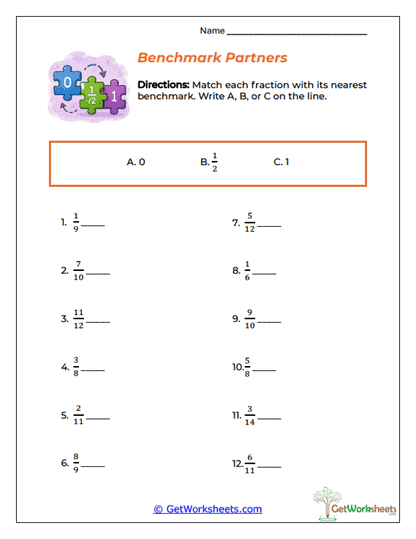
This worksheet gives students a quick matching challenge where every fraction must find its closest benchmark partner: 0, 1/2, or 1. Students look at fractions such as 1/9, 7/10, 11/12, and 5/8, judge their size, and then match each one to the benchmark it most closely resembles. The activity strengthens fraction estimation, benchmark fractions, numerator and denominator relationships, comparison, magnitude, mental math, and number sense without requiring students to convert every fraction into a decimal. It is especially useful for grades 4-5 students who are learning to look at a fraction and quickly recognize whether it represents a tiny amount, about half, or nearly one whole.
Academic Focus
- Match Fractions to Benchmarks: Students decide whether each fraction belongs closest to 0, 1/2, or 1.
- Judge Fraction Magnitude: Learners focus on the actual size of the fraction rather than only looking at the numerator or denominator separately.
- Use Half as a Reference Point: Students strengthen their understanding of what makes a fraction less than, near, or greater than one-half.
- Estimate Without Converting: The activity encourages efficient fraction thinking without needing decimals or complicated common-denominator work.
Learning Benefits
- Easy for Parents to Explain: Ask, “Is this fraction almost nothing, about half, or almost a whole?”
- Feels Like a Matching Game: Writing A, B, or C keeps the practice simple and fast-moving.
- Builds Fraction Intuition: Students begin recognizing common fraction sizes without having to calculate every time.
- Supports Mental Math: Children can often solve by comparing the numerator with half or all of the denominator.
- Great for Review: The worksheet works well for homework, centers, warm-ups, intervention, or homeschool lessons.
This worksheet helps fractions feel less mysterious because students are always comparing them with three familiar landing spots. Benchmark fractions, estimation, numerator-denominator relationships, comparison, magnitude, mental reasoning, and number sense all work together as students make each match. For parents, the strategy can be as simple as noticing that 1/9 is only a small piece of the whole while 11/12 is missing just one small piece. Those kinds of observations build a much stronger understanding of fractions than memorizing isolated procedures. In classroom and homeschool settings, this activity prepares students for estimating fraction operations, ordering fractions, and checking whether later answers are reasonable.
Bookmark Us Now!
New, high-quality worksheets are added every week! Do not miss out!