Reason Round
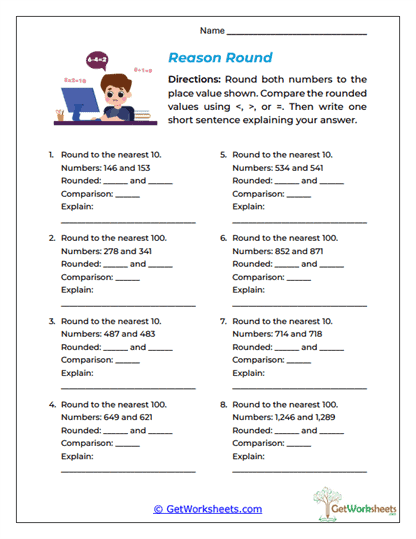
This worksheet takes rounding and comparison one step further by asking students to explain their reasoning in writing. Students round each pair of numbers to the nearest ten or hundred, compare the rounded values with <, >, or =, and then write a short sentence explaining why the comparison is correct. That structure strengthens rounding, place value, comparison symbols, estimation, mathematical vocabulary, written reasoning, and number sense while helping students move beyond simply recording an answer. It is especially useful for grades 4-5 students who can perform the math but need more practice communicating how they know their answer makes sense.
Targeted Skills
- Round Accurately: Students find the correct nearest-ten or nearest-hundred value for both numbers.
- Compare Rounded Results: Learners use <, >, or = after completing the rounding step.
- Explain Mathematical Thinking: Students write a short reason that supports the comparison they chose.
- Use Precise Math Language: The activity encourages vocabulary involving place value, greater than, less than, equal to, and rounded values.
Instructional Benefits
- Moves Beyond Answer-Only Math: Students must explain why the comparison works instead of stopping at a symbol.
- Great for Parent Conversations: Adults can ask, “Tell me why you chose that symbol using the rounded numbers.”
- Strengthens Communication Skills: Writing a mathematical explanation helps children organize their thinking clearly.
- Useful for Assessment: Teachers can tell whether students truly understand the comparison or simply guessed the correct symbol.
- Supports Deeper Learning: The worksheet combines computation, reasoning, and written explanation in one activity.
This worksheet helps students show what they know instead of only showing what they got. Rounding, place value, comparison, explanation, estimation, equality, mathematical language, and number sense all work together as students justify each answer. For parents, the explanation step is especially useful because it reveals whether the child actually understands why 650 is greater than 600 or why two rounded values might be equal. That kind of reasoning becomes increasingly important as students move into more advanced math where showing how they reached an answer matters just as much as the answer itself. In classroom and homeschool settings, this activity builds confidence, communication, and a deeper understanding of rounded-number relationships.
Bookmark Us Now!
New, high-quality worksheets are added every week! Do not miss out!