Benchmark Bounce
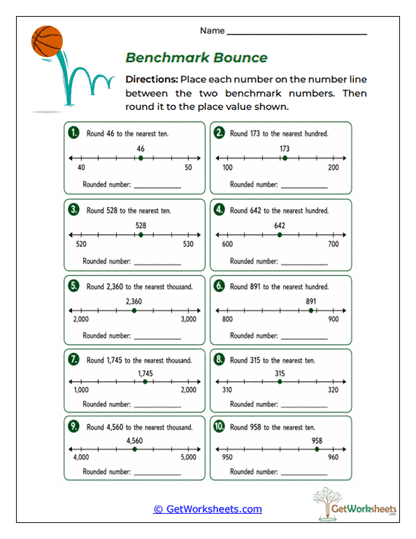
This worksheet helps students see rounding instead of only memorizing a rule by placing each number between two benchmark values on a number line. Students look at numbers such as 46, 173, 528, 642, and 2,360, decide which benchmark the number is closer to, and then round to the nearest ten, hundred, or thousand as directed. That visual approach strengthens rounding, place value, number lines, benchmark numbers, distance, estimation, and number sense while giving students a concrete way to understand why a number rounds up or down. It is especially useful for grades 3-4 students who may know the phrase “five or more, round up” but need a clearer picture of what rounding actually means.
Learning Goals
- Use Benchmark Numbers: Students identify the lower and upper multiples that surround the number being rounded.
- Compare Distance on a Number Line: Learners decide which benchmark is closer rather than relying only on a memorized chant.
- Round Across Place Values: Problems include nearest-ten, nearest-hundred, and nearest-thousand practice.
- Strengthen Visual Number Sense: Students connect the physical position of a number with the rounded value it represents.
Classroom & Home Use
- Excellent for Visual Learners: The number line gives students something they can actually look at when deciding which direction to round.
- Parent-Friendly Explanation: Adults can ask, “Which two numbers is this between, and which one is it closer to?”
- Makes Midpoints Easier to Understand: Students can see when a value is near the halfway point between two benchmarks.
- Supports Intervention: The visual structure is especially helpful for students who struggle when rounding is taught only with digits and rules.
- Flexible No-Prep Practice: The worksheet works well for centers, homework, guided practice, review, or homeschool lessons.
This worksheet is valuable because it connects rounding to distance, which is really what the skill is about. Number lines, benchmark values, tens, hundreds, thousands, place value, estimation, and number sense all work together as students decide where each number belongs. For parents, the easiest explanation is that the child is asking, “Which friendly number is this closest to?” rather than trying to remember a mysterious rule. A number such as 642 sits between 600 and 700, so the visual makes the decision much easier to understand. In classroom and homeschool settings, this activity helps students build a deeper and more lasting understanding of rounding while increasing confidence with larger numbers.
Bookmark Us Now!
New, high-quality worksheets are added every week! Do not miss out!