Estimate Corrections
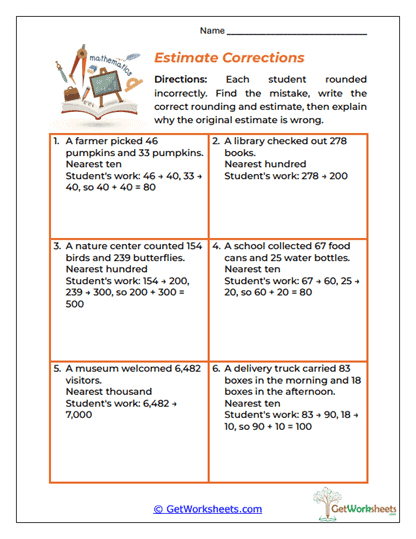
This worksheet turns rounding mistakes into a learning opportunity by asking students to inspect another student’s work, find the error, and correct both the rounding and the final estimate. Each problem shows a short real-world situation, the place value that should have been used, and a student’s incorrect or questionable estimate involving pumpkins, library books, nature counts, food collections, museum visitors, and delivery boxes. Students must use rounding, place value, addition, estimation, error analysis, number sense, and mathematical explanation to figure out what went wrong and why. It is especially useful for grades 3-5 students who already know the basic rounding rules and are ready to prove they understand them well enough to spot someone else’s mistakes.
Key Learning Objectives
- Check Rounding Accuracy: Students decide whether each number was rounded correctly to the nearest ten, hundred, or thousand.
- Correct the Estimate: Learners repair the rounded numbers and then recompute the estimated total.
- Explain the Mistake: Students think about why the original estimate was incorrect instead of simply replacing it with a new answer.
- Strengthen Place-Value Understanding: The worksheet reinforces how one digit can determine whether a number rounds up or down.
Instructional Benefits
- Makes Errors Useful: Students learn that a wrong answer can reveal exactly which skill needs attention.
- Great for Parent Conversations: Adults can ask, “Which digit tells us whether to round up or down?” and then “What should the estimate be?”
- Builds Self-Checking Habits: Correcting another student’s work can help children notice similar mistakes in their own math.
- Supports Written Reasoning: Explaining why an estimate is wrong encourages deeper understanding than simply circling an answer.
- Flexible for Review: The worksheet works well for small groups, homework, intervention, assessment, or homeschool practice.
This worksheet helps students move beyond memorizing the phrase “five or more, raise the score” and toward actually understanding what rounding does to a number. Rounding, place value, addition, estimation, error analysis, correction, mathematical reasoning, and number sense all come together as students investigate each example. For parents, the important point is that the child is learning to check the process, not just the final answer. If 278 is supposed to round to the nearest hundred, a student needs to know why 300 is reasonable and 200 is not. In classroom and homeschool settings, this kind of error analysis builds stronger confidence, sharper attention to place value, and a more independent habit of checking whether an estimate makes sense.
Bookmark Us Now!
New, high-quality worksheets are added every week! Do not miss out!