Pie Puzzle
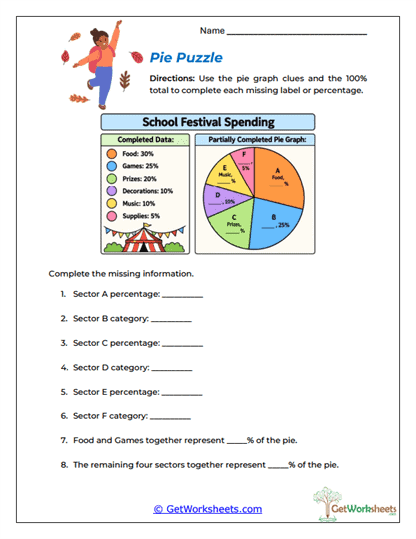
The Pie Puzzle Worksheet helps students use known percentages and category information to fill in missing parts of a partially completed pie graph. Students study a school festival spending chart, compare the completed data list with the labeled sectors, and determine missing percentages, categories, and combined totals. This is a strong upper elementary and middle school graphing activity because students must connect written data to a visual pie graph while remembering that all sectors together represent 100% of the whole. The worksheet strengthens pie graph interpretation, missing-value reasoning, percentage addition, category matching, part-to-whole relationships, sector analysis, and data completion.
Learning Goals
- Complete Missing Sectors: Students use the provided data to determine unknown percentages and category labels.
- Use the 100% Whole: Learners remember that all pie graph sectors must add to a complete 100%.
- Match Categories to Percentages: Students connect each section of the graph to the correct spending category.
- Combine Sector Values: Learners add two or more percentages to answer questions about larger portions of the pie.
Teaching Advantages
- Builds Multi-Step Reasoning: Students must compare several pieces of information before filling in each missing value.
- Strengthens Graph-to-Data Connections: The activity helps children move between a written data list and a visual pie graph.
- Useful for Review: Teachers and parents can see whether students understand sectors, percentages, and category labels together.
- Low-Prep Resource: Works well for classwork, homework, tutoring, intervention, assessment, or homeschool practice.
Completing a partially finished pie graph helps students understand how all parts of a data display work together. This worksheet reinforces percentages, sectors, categories, totals, legends, part-to-whole relationships, missing values, and pie graph interpretation through a puzzle-style activity. Students build confidence as they use the information they already know to solve what is missing. In classroom and homeschool settings, this practice strengthens graph comprehension, percentage fluency, problem solving, and mathematical reasoning. These skills prepare students for constructing pie graphs, checking data accuracy, and solving more advanced percentage and statistics problems.
Bookmark Us Now!
New, high-quality worksheets are added every week! Do not miss out!