Reciprocal for Negatives
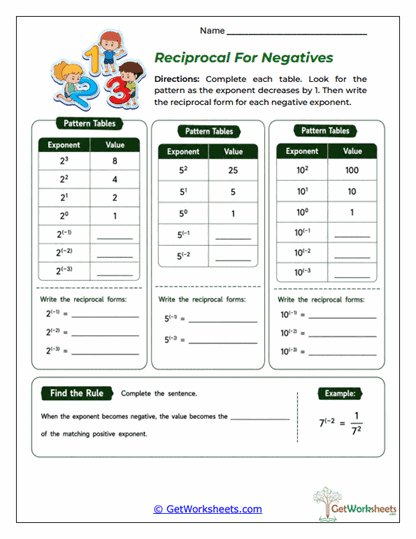
The Reciprocal for Negatives Worksheet helps students understand what happens when a power changes from positive to zero to negative. Students study pattern tables, compare positive powers, notice how values change by division, and then write the matching reciprocal form for each negative power. This is a strong fit for grades 6-7 because it shows the rule as a pattern instead of asking students to memorize it with no explanation. For parents, the big idea is simple: as the power drops below zero, the value does not become negative; instead, the expression becomes a fraction with the positive power in the denominator.
Learning Goals
- Recognize Number Patterns: Students track how values change as powers decrease from positive to zero and then negative.
- Write Reciprocal Forms: Learners rewrite negative powers as fractions with positive powers in the denominator.
- Understand Zero as a Bridge: Students see how the value at power zero connects the positive and negative sides of the pattern.
- Explain the Rule: The worksheet asks students to complete a sentence describing what happens when a power becomes negative.
Teaching Advantages
- Shows Where the Rule Comes From: Pattern tables make the reciprocal relationship visible instead of mysterious.
- Parent-Friendly Structure: Families can follow the rows downward and ask, “What are we dividing by each time?”
- Useful for Guided Practice: Teachers can model one table and let students complete the others independently.
- Low-Prep Review: The page works well for classwork, homework, intervention, or homeschool instruction.
Students build stronger understanding of negative powers, reciprocals, positive powers, pattern tables, division patterns, and fraction form by watching the values change step by step. This matters because one of the most common mistakes is thinking a negative power makes the whole number negative. In the classroom, teachers can use the tables to show that the change is really about moving a factor into the denominator. At home, parents can reinforce the idea by tracing the pattern from 22 down to 20 and then beyond. That kind of pattern-based reasoning improves comprehension, accuracy, and confidence. It also gives students a much stronger foundation for simplifying algebraic fractions later.
Bookmark Us Now!
New, high-quality worksheets are added every week! Do not miss out!