Missing Powers Puzzle
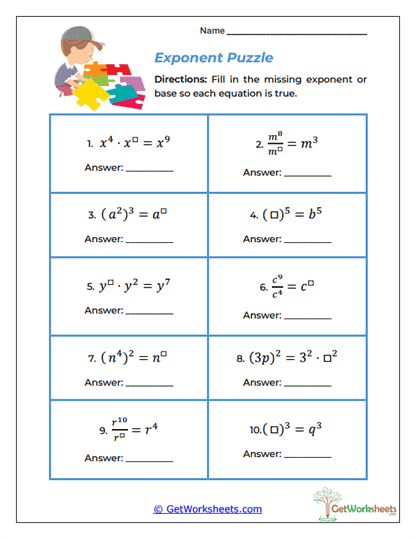
The Missing Powers Puzzle Worksheet turns power rules into a reasoning activity by asking students to find the number, power, or base that makes each equation true. Rather than being given a complete expression to simplify, students examine the base, compare the powers, recognize the operation, and work backward to determine the missing value. The problems include multiplication, division, powers raised to powers, and powers applied to grouped expressions, so students must think carefully about the relationship between both sides of each equation. This type of practice is appropriate for grades 6-7 and is especially helpful once students understand the basic rules but need practice applying them in a less predictable format.
Instructional Objectives
- Solve for Missing Values: Students use known relationships between powers to determine an unknown number or variable.
- Apply Rules Backward: Learners practice reversing familiar procedures, which strengthens understanding beyond simple memorization.
- Analyze Both Sides of an Equation: Students compare equivalent expressions and use equality as evidence for what the missing value must be.
- Develop Flexible Reasoning: Mixed problem types require students to decide which mathematical relationship applies rather than following one repeated procedure.
How This Helps
- Encourages Thinking Instead of Guessing: Students must use the information already present in the equation to justify the missing value.
- Provides a Gentle Algebra Connection: Finding an unknown introduces algebraic thinking without requiring complicated equations.
- Works for Multiple Settings: The worksheet can be used for independent practice, small groups, homework, enrichment, or homeschool instruction.
- Reveals Misunderstandings Quickly: Incorrect answers can show whether a student is confusing multiplication, division, or power rules.
Missing-value problems are useful because they force students to understand the relationship among bases, powers, products, quotients, equivalent expressions, and unknown values. A student who has only memorized a rule may struggle at first, while a student who understands why the rule works can reason backward and find the answer. That makes this worksheet a strong way to check whether learning is becoming flexible and meaningful. In the classroom, teachers can use individual problems for discussion and ask students to explain how they knew what belonged in the blank. At home, parents can encourage children to compare the left and right sides and ask, “What would have to happen for these two sides to match?” As students become comfortable solving these puzzles, they build reasoning, accuracy, algebra readiness, and confidence with increasingly complex power expressions.
Bookmark Us Now!
New, high-quality worksheets are added every week! Do not miss out!