Diamond Color Rhythm
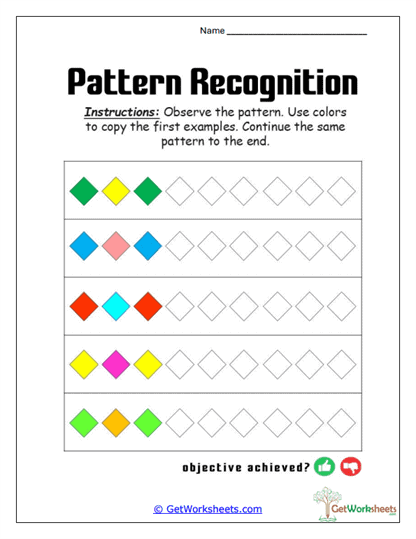
The Diamond Color Rhythm Worksheet helps children recognize a repeating sequence in which the first color returns after a different middle color. Students study three colored diamond shapes, identify the ABA pattern, and then continue the same color rhythm, order, repetition, and visual sequence across the remaining diamonds. This is appropriate for preschool and kindergarten because the consistent shape allows children to focus completely on the color relationship and recognize that the first and third positions match. For parents, the idea is simple: children learn to hear and see the pattern as “green, yellow, green,” then repeat that same three-part arrangement again.
Key Learning Objectives
- Identify ABA Patterns: Students recognize that the first and third items in the repeating unit are the same.
- Predict the Next Color: Learners use the established order to determine which color should appear next.
- Maintain Sequence Order: Students practice repeating the complete three-part unit without changing its arrangement.
- Develop Pattern Vocabulary: Children gain experience describing what repeats and which positions match.
Classroom & Home Use
- Encourages Careful Observation: Students must notice that two positions match while the middle position changes.
- Supports Verbal Learning: Saying the pattern aloud helps children remember the sequence while coloring.
- Useful for Early Math Centers: The page fits independent practice, small groups, morning work, or intervention.
- Simple for Family Practice: Parents can recreate ABA patterns with toys, snacks, socks, or household objects.
Students strengthen ABA sequencing, visual patterns, color recognition, prediction, repetition, and working memory as they complete each row. This type of pattern is useful because children begin learning that repetition does not always mean simple alternating pairs. In the classroom, teachers can have students tap each diamond and say the colors before they begin filling in the blanks. At home, parents might build a pattern such as fork, spoon, fork and ask what should come next. Those simple examples make the mathematical rule more concrete. As students practice recognizing and extending ABA sequences, they build confidence, attention to detail, and stronger early problem-solving skills.
Bookmark Us Now!
New, high-quality worksheets are added every week! Do not miss out!