Continuing Three-Color Heart Patterns
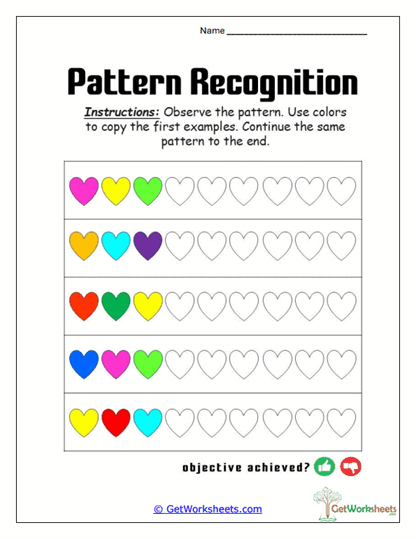
The Pattern Recognition Worksheet introduces children to repeating sequences that use three different colors instead of only two. Students look at the first three colored hearts, determine the ABC pattern, and continue that same three-part sequence across the remaining outlined hearts. This is a strong fit for preschool through kindergarten because it increases the thinking challenge while keeping the picture itself familiar and easy to follow. For parents, an ABC pattern simply means three different items repeat in the same order, such as pink, yellow, green, then pink, yellow, green again.
Targeted Skills
- Recognize ABC Patterns: Students identify a repeating unit made from three different colors.
- Maintain Correct Sequence: Learners remember all three parts and repeat them in the proper order.
- Use Visual Prediction: Students determine which color belongs in each blank heart based on the examples.
- Develop Working Memory: The three-color pattern asks children to hold a slightly longer sequence in mind while they work.
Learning Benefits
- Adds a Gentle Challenge: Moving from two-part to three-part patterns strengthens sequencing without making the task overwhelming.
- Supports Color Recognition: Students repeatedly identify, recall, and use different colors in a fixed order.
- Combines Math and Fine-Motor Practice: Coloring keeps the activity hands-on while reinforcing early mathematical thinking.
- Works in Multiple Settings: The worksheet is useful for preschool centers, kindergarten lessons, homework, or homeschool practice.
Students strengthen ABC patterns, sequencing, color recognition, prediction, working memory, and visual attention as they continue each row. The important lesson is that a pattern can contain more than two parts and still follow a dependable rule. In the classroom, teachers can encourage students to say all three colors aloud before coloring the next heart. At home, parents can copy the same pattern using crayons, toys, cereal pieces, or blocks so the child sees that the rule works with many different objects. This type of repeated practice helps children become more careful observers and more confident problem solvers. Those skills later support number patterns, counting sequences, classification, and early algebraic reasoning.
Bookmark Us Now!
New, high-quality worksheets are added every week! Do not miss out!